Showing posts with label Spotify. Show all posts

Saturday, October 17, 2020

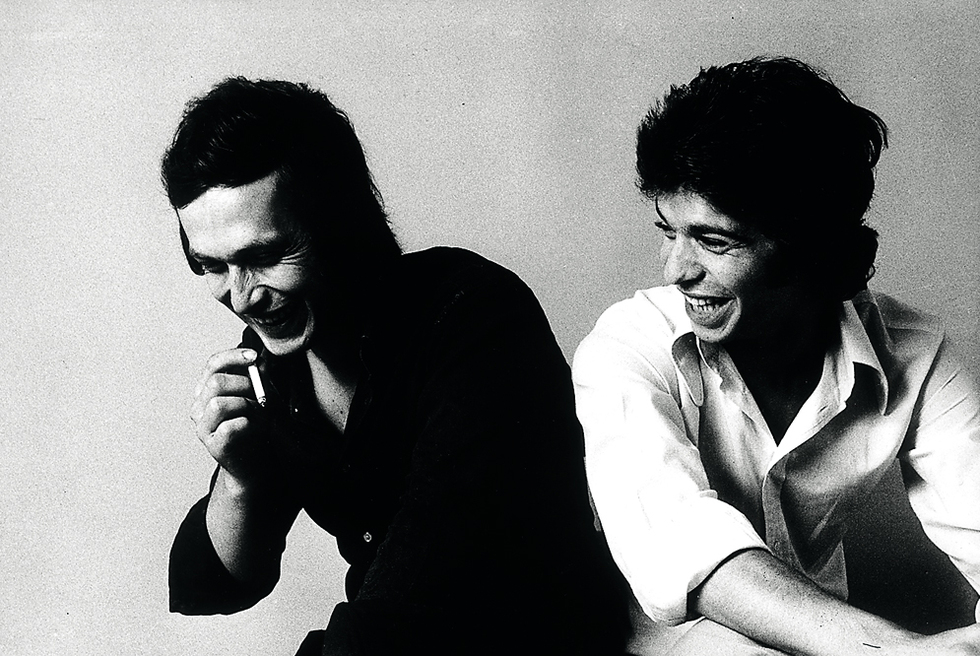
Sean Levitt, guitar master (1955-2002)

2021-02-03 update: after a couple of comments below by John Lyon, author of Sean Levitt—Seven Transcriptions, which includes the most complete biographical sketch I have seen of Levitt. I have corrected some mistakes, and have only added his complete name and the dates and places of his birth and death. 

~

While jazz lives are routinely thrown to the "tragic" bucket too easily, there are instances for which that label is fitting. Sean Levitt, an astounding jazz guitar player you may have never heard of, is one of those cases.

Sean Levitt in Salamanca, Spain, 1986 (Source)

Sunday, May 17, 2015

The King is dead, long live the blues

BB King by Naiel Ibarrola

BB King has died, and it feels like the end of an era. There are artists who seem to have been "always there"; in King's case, he was already playing when my father was a toddler; when he released his first hit, "Three O'Clock Blues", Elvis was 16. He's also the last world-wide known bluesman to have come from the cotton fields of Mississippi, where he was born in 1925. He certainly is the last bandleader to have gone from playing the "chitlin' circuit" to packing the most select venues in the world.

It is the end of an era.

Thursday, April 30, 2015

Hard bop repertory — a suggestion

(For Ira Gitler.)

The central position of hard bop in what is widely considered as the mainstream of jazz is an interesting phenomenon. It is paradoxical how despite its pervading presence, the lingua franca, thanks to the enormous recorded legacy, and even today, among students at music schools, there is very little literature about it. Whatever the reason, there are few biographies of musicians relevant to that genre — some don't amount to much more than listening guides —, and there's no definitive treaty of the music either (Rosenthal and Mathieson's books are clearly not enough), which, given that it would have to deal with African-American heritage more so than any other branch of jazz, it should be seriously considered by one or several scholars.

Going back to the first point, given the numbers of musicians who play in or around the hard-bop genre, among them many music students fresh out of schools, at least some of them must really like the music (in spite of all the cynicism by old farts who've seen it all). So here's my suggestion to those looking for a less-trodden path in that realm: why not explore Hank Mobley's compositions?

Hank Mobley at the Soul Station recording session, Sunday, February 7, 1960
(photography by Francis Wolff)

Monday, March 2, 2015

Steve Brown & Guillermo Bazzola

STEVE BROWN & GUILLERMO BAZZOLA
Una Pequeña Alegría
Brown Cats Productions (BC9508)

Guillermo Bazzola, Steve Brown (g).

Recorded on April 8, 2013. TT: 58:36

This record, "A Little Joy", is the latest by Steve Brown and Guillermo Bazzola, an unlikely duo of pares inter pares (the notes don't state who plays what) for its great gaps in age — rare but irrelevant — and geography: Brown is based in Ithaca, NY, whereas Bazzola lives in Madrid, Spain. Perhaps for this reason this was recorded as in olden times, in one day.

The guitar duo has a long tradition in jazz, but it's a tricky format. There's the sameness in sound, even with imaginative arrangements, and the unavoidable technical pyrotechnics. In this instance, the first notes here are not really promising: both guitars are close in timbre, a rather conventional clean jazz sound, and the tune is a bossa nova, a trap that can be either beautiful or terribly inconsequential.

Although pretty and with a certain weight, like many first tunes at live gigs, the opening "Caminhos Cruzados" (a Jobim song) works well but it's not representative of this record; the other bossa, "Esencia" (by Spanish pianist Alberto Conde) is played with more verve. It is with the second track, "Los Mareados" ("The Dizzy Ones"), where Brown and Bazzola do get down to business. This is an old tango brought to the session by Argentinian Bazzola, and its theme is performed with sensitivity and elegance. This a highlight of the record together with the other tango of the session, "Nada" ("Nothing"), whose beautiful melody is framed by the minute rhythmic nuances, the way the comping guitar falls ever so slightly behind the beat.

Friday, February 27, 2015

That stumbling feeling

Ah, rhythm! Possibly the most primitive element of music. It's there even if you don't want to: just listen to your heartbeat and your breathing. Anyone can relate to it, even if they cannot produce it consciously. It's in some of the most memorable moments in the history of music, from the beginning of Beethoven's Fifth, to Fats Domino "I'm Walkin'", Steve Reich's "Clapping Music", or what Art Blakey does on Thelonious Monk's original "Straight, No Chaser".

Rhythm may also be considered the unifying feature for a lot of contemporary music (so much so that in Denmark they have a "Rhythmic Music Conservatory" encompassing exactly that). In jazz it's such a central element that I wouldn't know where to begin.

There's a small feature that appears frequently, though, which is the playing "in three" over a four-beat rhythm. Sounds complicated? You just have to check out what this early Brad Mehldau trio does here from 0:25 onwards, and you'll get it immediately

Saturday, August 23, 2014

Brad Mehldau: the early years

Young Brad Mehldau, by John Abbott

Brad Mehldau is 44 today, which means that it's about twenty years since he first blipped in the radar, possibly, when he first recorded for a major label, Warner, as a sideman of Joshua Redman's, with whom he also toured the world that year.


Joshua Redman - ts, Brad Mehldau - p, Christian McBride - b, Brian Blade - d
San Sebastián (Spain) - July 25th, 1994


Since then, with this Art of the Trio series with Jorge Rossy and Larry Grenadier he made the classic piano trio fashionable and trendy, becoming one of the main young stars of jazz, a coop he has already flown. Even though he maintains his classic piano trio active, he's also involved in other projects that defy categorization. And more power to him for that.

Sunday, June 29, 2014

Following Eric Dolphy

For all the lack of audience and shaky economic prospects, your average jazz musician is someone who works very hard to master their instrument and knows music theory inside out. Even if it doesn't permeate all of it, there is, within jazz, an honourable tradition of art for art's sake, of the fight against oneself and the infinite choices offered by music and sound. In more detail, the profile of a jazz musician as a young person today would be someone who got started early in music, has gone through “classical” studies of some sort, is a versatile virtuoso with their instrument, and will have to go through New York City at some point of their lives as some sort of validation.

Just like Eric Dolphy.

Eric Dolphy by Naiel Ibarrola

Dolphy, together with Ornette Coleman and John Coltrane (he worked with both), was the most influential “reedman” to come up in the early 1960s. Be it on flute or, especially, on alto sax and bass clarinet, he established a way of playing that still sounds contemporary. By what can be heard today, I suspect that Dolphy has at least a comparable following among musicians, even though Coleman and Coltrane are more visible figures in the canon. But posterity is fickle.

Monday, April 28, 2014

Denzil Best's "Move"

Denzil Best pictured by Bill Gottlieb
Yesterday was the birthday of Denzil Best (1917-1965) a musician whose life was sadly defined by bad health. He started on trumpet, but had to abandon it when he was very young because of a pulmonary illness. He then went on to play the piano and bass, and finally the drums, on which his brushwork was masterful. Later in life he had problems with his wrists, and finally died after an accident.

Interestingly, in spite of a few good recordings, his place in posterity is secured because of a number of compositions. "Allen's Alley" (a/k/a "Wee"), "Dee Dee's Dance", "45-Degree Angle" (later modified by Herbie Nichols), "Bemsha Swing" (co-signed with Thelonious Monk), and his most famous opus, "Move". Now you'll see why Best deserves all the posterity we can get him.

Tuesday, April 15, 2014

Billie Holiday, Club Bali... and the Internet

It’s funny how some people sometimes long for the great filters of olden days, when there was no internet, from record producers and publicists who had some influence on what music was commercially released or not, to professional journalists and editors who produced well-written, fact-checked copy. Those filters were by no means perfect, but they had their role.

Consider this picture. It was, probably still is, one of the first results when you type “Ray Bauduc”, “Walter Page” or “Claude Hopkins” on the world’s most-used search engine (owners of the blog-platform you’re reading this on). Those are minor names in the great scheme of Western culture. If you type “Billie Holiday”, you’ll probably see this picture too sooner than later.


Thing is, those are not Ray Bauduc, Walter Page or Claude Hopkins.

Monday, April 7, 2014

Kit Downes & Tom Challenger: Wedding Music live at Royal Festival Hall

The Royal Festival Hall is hosting an organ season to celebrate the culmination of the three-year long refurbishment works to bring back its organ to life, with its 7,866 pipes laid along the span of the stage.

The organ at Royal Festival Hall, refurbished (© Nick Rochowski)

Tuesday, March 25, 2014

Portrait of Cecil Taylor as a young man

Playing the music(s) we call jazz is not an easy life, neither regarding the art itself, nor as a way to make a living. The reasons for anyone to follow that path fall beyond the realm of logic; art is a tricky business, and longevity and sheer stubbornness do not necessarily bring about recognition and financial support for the artist’s work. Luck and chance can make or break a career. Even so, there are men and women who work relentlessly to realize whatever shakes their spirits. If there is one musician who’s taken his art to an overwhelming standard of technical virtuosity, swimming against the strongest tides of disapproval, that must be Cecil Taylor, who turns 85 today.

© Naiel Ibarrola, 2014
Years before Ornette put any music on record, before Coltrane stepped firmly into the unknown, Taylor was hammering his way into the scene in New York, but he never quite made it, even if he was the first jazz act at the now legendary Five Spot, turning it into a bona fide jazz venue. He was not only aware of jazz and its traditions, but he claimed that his approach to form and composition was based on Duke Ellington's, and, being an astonishing virtuoso, had very definite ideas on the value and role of technique in fellow pianists such as Thelonious Monk and Horace Silver, two clear instances of technique being the consequence of the music itself. Even so, his arrival must have been similar to Henry Cowell's in the "classical" world, thirty or forty years earlier.

Tuesday, March 18, 2014

Paco de Lucía: an introduction in tangos, and a PS

In the obituaries devoted to Paco de Lucía, the comments have focused on his adventures beyond Flamenco and its fusion with other musics, but in actual fact he never strayed too far from his roots and the vast majority of his recordings can still be sorted in the palos, the different forms of the genre. As he himself said "there are other musics I admire, but they don't make me feel like Flamenco does. It just breaks you."

Paco de Lucía and Camarón de la Isla (picture by José Lamarca)
Among those palos, tangos — which, like Camarón and Paco, come from around Cádiz — must be the easiest to enjoy for anyone used to the 4/4 ever-present in pop, rock and a great deal of jazz. It not only shares the four-beat signature, but the accents also tend to fall on beats 2 and 4, where your typical hi-hat or snare drum wouldn't be so out of place.

Monday, March 3, 2014

RIP Francisco Sánchez

Francisco Sánchez, a/k/a Paco de Lucía (picture: ABC)
Francisco Sánchez's passing will leave us without new adventures of Paco de Lucía, the shivers when he appeared on the stage, the ecstasy at the end of a concert. It will divide music lovers between those of us who saw him live and those who didn't. These will have to make do with a sizable amount of recordings and video footage he leaves behind, evidence of the several lives that Francisco Sánchez was able to fit in Paco's: Francisco Sánchez was just 66 when he died, but Paco had been a working musician for over fifty years. So much for Andalusians being lazy and all that.

For me, a child in the Seventies, my first impression of Paco, on TV, was that of a charismatic, handsome, and very serious-looking guy. He had long hair, parted on the side, and although he dressed in a contemporary way, he seemed to follow Seventies fashion from a prudent distance; still in his twenties, he was young too. And he played very fast.

Paco on TVE

Friday, February 21, 2014

Random Dameronia

Tadd Dameron, c. 1946-48
(Bill Gottlieb/LoC)
Jazz has improvisation at its core, true, but ignoring composition and arranging would be a gross oversimplification and a mis-representation of the music. One of the great composers in its great tradition was Tadd Dameron, born on a day like this in 1917.

This is just a random sample of his compositions.

Monday, February 17, 2014

ND — Carlos Montoya: From St. Louis to Seville (and a book...)

Carlos Montoya: From St. Louis to Seville
(RCA/Victor LPM-1986)

This new entry in the infrequent series Notes on discography (ND) is about an early experiment in jazz-flamenco fusion. From St. Louis to Seville is an album by Carlos Montoya published in 1959, at a time when the recording business was booming partly thanks to the mass introduction of stereo and hi-fi, flamenco had began to be well known in the US, and jazz was going through a sweet spot in its history. The significance of this LP is more historical than musical, given the context of both flamenco (think Sabicas) or jazz at the time, or even the meeting of jazz and Spanish music arranged by Miles Davis and Gil Evans about a year later in their Sketches of Spain.

Saturday, February 1, 2014

A 60th birthday of rock guitar (possibly)

Fans of any kind of music just love a good discussion on pioneers, on who was the first to do something, and none more so than electric guitar fans. The heroic, macho player, not too different from characters in James Bond or Western movies (guitar slingers, guitar heroes...), lends itself to this kind of speculation.

One such discussion about the first guitar hero recently involved sailing upstream your typical "great man" narrative. Take, say, Eddie Van Halen. Hendrix. That kind of revered, popular guitarist. Jeff Beck. Clapton. Electric wizards with very heavy blues leanings. Creators of new sonic worlds on a fairly new equipment and its complements, of new techniques, new resources, uniquely able to stand in front of tens of thousands mesmerized people. Mike Bloomfield, co-conspirator of Bob Dylan's electrified and electrifying appearance in Newport. And then, circa 1960, the tracks seem to disappear. However, if I had to point to an early example of really outrageous guitar, combining a very early date of recording and release to the public, and ground-breaking playing, my vote would go for a tune recorded 60 years ago today. This one:

(Play as LOUD as possible)


Yep. That is "Space Guitar", a tune Johnny 'Guitar' Watson recorded, two days short of his 19th birthday, on February 1, 1954. It was released the following month as by "Young John Watson" on the Federal label as single #12175 (b/w "Half Pint A-Whiskey").

Sunday, December 22, 2013

Happy festivities and a musical suggestion

Part of my friends and readers, those in the Southern hemisphere, are about to celebrate the Summer, not Winter, Solstice (you dirty rats!), and the end of the year it's just a convention, but be it because days grow shorter on this side of the world, or because most of us will be on a break from work, or for cultural reasons, this is a time for reflection or celebration. So do reflect, and whatever you celebrate, have a great one.

I wasn't really planning on recommending any music for this time of the year. Best-of-the-year lists abound, and there's all the Christmas-y stuff. It'd feel like choosing more candy on top of all the candy we're all being shoved down our throats. 

But then I came across the video about Bob Brookmeyer (see previous entry), and I suddenly heard Jack Teagarden. With strings. In a record I didn't have a clue about. It has Teagarden's voice and trombone, arrangements by Claus Ogerman, Brookmeyer, and Russ Case, and, surprisingly, the tunes are by Willard Robison, whose name is probably less known than some of his tunes, like "Old Folks" or "Cottage for Sale".

The record is Think Well of Me (Verve V6 8465 in stereo, V-8465 in mono) recorded and released in 1962. It was reissued as a limited edition on CD (Verve 314 557 101-2, from 1998, there are second-hand copies around), and it's also on Spotify. There are several uploads on YouTube, and I have compiled this playlist:


Have a great one, best wishes for 2014, and "see" you then.

Tuesday, November 26, 2013

November 26, 1945 at Savoy Records

(Image from London Jazz Collector)
"Hen Gates" is Dizzy Gillespie


Monday, November 26, 1945. Just another day at the office for the small independent Savoy Records label from New Jersey, for which they booked WOR Studios in Manhattan. First on, Don Byas and his quintet:

Benny Harris (trumpet) Don Byas (tenor sax) Jimmy Jones (piano) John Levy (bass) Fred Radcliffe (drums)
   S5845    Candy
   S5846    How High The Moon
   S5847    Don By
   S5848    Byas-A-Drink

Next up (note the consecutive matrix numbers), the quintet lead by Charlie Parker, in his first ever session as a leader:

Miles Davis (trumpet) Charlie Parker (alto sax) Argonne Thornton (a/k/a Sadik Hakim, piano) Dizzy Gillespie (trumpet* and piano) Curley Russell (bass) Max Roach (drums)

WOR Studios, Broadway, NYC, November 26, 1945
   S5849-1  Warming Up A Riff
   S5850-1  Billie's Bounce
   S5850-2  Billie's Bounce
   S5850-3  Billie's Bounce
   S5850-4  Billie's Bounce
   S5850-5  Billie's Bounce
   S5851-1  Now's The Time
   S5851-2  Now's The Time
   S5851-3  Now's The Time
   S5851-4  Now's The Time
   S5852-1  Thriving On A Riff
   S5852-2  Thriving On A Riff
   S5852-3  Thriving On A Riff
            Meandering
   S5853-1  Ko Ko * 
   S5853-2  Ko Ko *

Listen to the music on YouTube or Spotify (below).


Thursday, October 10, 2013

Monk's pieces

(2022-10-10 update: the Black Lion recordings are now available on streaming platforms. I have also added the late Frank Kimbrough's take on "A Merrier Christmas". The playlist is now also on Qobuz in SQ equal to or above CD.)

Because of his name, his looks, his life, the way he played, which some see as some sort of overarching weirdness, Thelonious Monk is one of last century’s most recognizable jazz musicians.

He was a very interesting composer too. Firmly anchored in the popular-song-and-blues genre, he left under a hundred pieces, some which have become well-known standards.

However, there's much more than the half-dozen overused items of Monkiana that we all know. Since today it's his birthday, I'm posting this almost-complete Spotify playlist, based on the list of Monk's compositions at MonkZone website, with all that is known and, perhaps, not so known from him.

Missing from the playlist are "Harlem Is Awfully Messy" (copyrighted but never recorded), and "A Merrier Christmas" (of which there's a private recording with Monk singing—this version is by Dianne Reeves with Benny Green).

Comments, additions, corrections, will be most welcome.

Thursday, July 18, 2013

The Blues: black, white... and red? (and III)

With today's text we reach the end of the excerpt first published on line by UTNE Reader from The Guitar and the New World, the new book by Joe Gioia. Once again, our thanks go to the author and the publisher, SUNY Press. If the earlier parts (the first and the second) sound interesting enough, the rest of the chapter “Hey-Hey” digs wider and deeper into some of the points made so far.

As it has happened with some of the books mentioned by Gioia in the second part (especially Hamilton's), his may be difficult to accept for its ground-breaking view of the origins of the blues, a unique genre about which people have been capable of keeping a straight face while talking of deals with the devil. On the other hand, Gioia's book may well go through the same heavy revisions as Charters's and Oliver's books in the future. Even in that case, the oversight Native Americans have suffered in this whole story of the music of North America is so enormous, that what's really important in Gioia's discourse is not so much whether his answers are correct, but the questions he asks; not what he's found, but the fact that he's pointing his torch in a different and hardly explored direction.

At "worst", the book can also be used as the author's guide to North-American music from the first half of the 20th century. Although some tracks may seem out of place without the book at hand, almost all the songs he mentions are included, in order of appearance, in this Spotify playlist (the links in the text lead to YouTube).

Back to the text: Having argued that there is sufficient reason to consider seriously the role of Native Americans in the origins of the blues and other musics from the US, the author keeps following that trail, and he begins to find some clues...