Showing posts with label Miles Davis. Show all posts

Friday, February 27, 2026

Miles Davis at Newport '58: photos and a bit of footage

The fourth (4th) edition of the Newport Jazz Festival took place in 1958. A sizeable bit of it was included in the film Jazz on a Summer's Day, but not all. If, for instance, we look at the At Newport albums released by Columbia from that year, it's obvious that even though the selection in the film is most welcome, it is incomplete. One of the reasons is that, due to technical issues, footage from the first day was deemed unusable (last-minute reinforcements were brought and things did work from the second day onwards). Alas, one of the bands playing on the first day, July 3, and, therefore, not in the film, was the short-lived Miles Davis sextet Cannonball Adderley, John Coltrane, Bill Evans, Paul Chambers and Jimmy Cobb: the Kind of Blue band.

Not long ago, some unused film from that festival resurfaced, but its still pending research and/or release, as far as I know. In any case, we do have the sound of Miles's sextet.

Listen on Qobuz/YouTube

It looks like Miles Davis, together with his partner at the time, Frances Taylor, spent more than one day at Newport.

Gerry Mulligan, Frances Taylor, Miles Davis


Frances Taylor and Miles Davis (source)

Thanks to improvements in the quality of screens and the remastering of films in HD, today it's possible to catch details that may have gone previously unnoticed (like in this photo by Herman Leonard or this footage of Monk). As it happens, on Jazz on a Summer's Day, during Thelonious Monk's performance, we can see Miles Davis, Frances Taylor, possibly Symphony Sid doing a beeline to greet Miles and, on the bottom left corner, bassist Bill Crow, who would perform as part of Gerry Mulligan's Quartet with Art Farmer (they're in the film).

[1] Bill Crow [2] Miles Davis [3] Frances Taylor

[1] Bill Crow, [2] Miles Davis,
[3] Frances Taylor, [4] Symphony Sid(?)

Friday, December 15, 2023

Miles Ahead in images

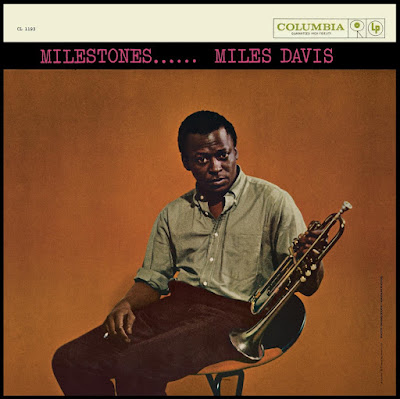
Some time ago, I put together Dennis Stock's photos from the first session for Miles Davis's Milestones record.

We now turn to one of the sessions for Miles Ahead, the first Miles Davis/Gil Evans collaboration for Columbia, a relevant LP in Miles Davis's career for its commercial success (the infamous change of covers was made easier by the speed at which runs of prints sold out). The photographs were taken in May 1957 at Columbia's studio on 30th St, Manhattan, and they come from Miles Davis's official website, where they do not carry information on location, date or personnel. From the credits in the Complete Miles/Evans Sony set, we know they were taken by Don Hunstein, Columbia's staff photographer.

Second and final LP cover (source)

The most significant image is the one showing the ensemble (except bass and drums), because it shows the positions of musicians and microphones (a grand total of four were used) to record an orchestra out of balance between the brass (one microphone in the middle for five trumpets, four trombones, two French horns and one tuba) and the "reeds" (one microphone for four chairs sharing alto sax/clarinets/flutes/oboe). As the (almost) only soloist, Davis has his own microphone, and I guess the fourth was for bass and drums, out of frame (click on the images to enlarge them).

Wednesday, October 5, 2022

On Oscar Pettiford's centennial


Oscar Pettiford in Newport, 1958
(screenshot from Jazz on a Summer's Day)

While on April 22 we celebrated the 100th birthday of the very well-known Charles Mingus (article/podcast in Spanish), on Friday, September 30th, we did the same for the other great bassist/leader of the era, even though not as well-remembered as Mingus, but, back in the day—he passed away in 1960—as respected and admired: Oscar Pettiford.

Friday, February 4, 2022

Miles Davis: February 4th, 1958—in pictures

On Tuesday, February 4th, 1958, at Columbia Records' studio on Manhattan's 30th St., a session was booked for the afternoon. It lasted from 2 to 6.30 pm, with Harry "Chappy" Chapman, an in-house veteran going back to the early 1940s, manning the control room. 

The musicians and producer involved may have not known it at the time, but this was to be the first of two momentous occasions: this session and the following one, on March 4, were to be the last produced for Miles Davis by George Avakian, who had put him in the map by signing him to Columbia, the label he ended up staying with for thirty years, between 1955 and 1985. 

These sessions on February and March 4 would also be the last ones by Davis's "first quintet", with Red Garland on piano and "Philly" Joe Jones on drums. Together, they'd form Milestones, a, er, milestone in Miles Davis's career, which may have seemed unsurpassable at the time. Not for long, though: his next small group album would be Kind of Blue.

Cover of Milestones. Photograph by Dennis Stock.

Saturday, May 8, 2021

Bud Powell with the 'Birth of the Cool' nonet

Bud Powell at Birdland

One the many discoveries made by Peter Pullman in his definitive biography of Bud Powell is that the pianist sat in once with Miles Davis's short-lived Nonet, of "Birth of the Cool" fame. 

We know the regular pianist was John Lewis, who also contributed a number of arrangements ("Move", "Budo", "Why Do I Love You") and compositions ("Rouge", "S'il Vous Plaît") and is present in all the recordings except the first studio session, where he was replaced by Al Haig. 

According to Pullman, Powell's sitting in took place some time in 1950 at Birdland. In his book (pp. 138-139) he quotes extensively from budding pianist Sy Johnson, then just about 20 years old and living in Connecticut, for whom the trip to New York City to see and listen the Miles Davis Nonet (and the Lennie Tristano Sextet) must have been a special occasion, even though it wasn't remembered by any of the musicians Johnson spoke to years later.

Sunday, April 26, 2020

Paul Chambers plays the mambo (sort of)

Paul Chambers in 1958
 by Dennis Stock
Boxed multi-disk sets are wonderful, but they can be a challenge to assimilate. Case in point, the sensational Miles Davis - Gil Evans: The Complete Columbia Studio Recordings, released in 1996. It comprises six CDs full of music that gave us four albums, so you do the math: it contains a lot of music with a lot of repetition.

However, some attentive listening with the appropriate equipment—enough sound on all frequencies, particularly the bass—can unveil treasures such as Paul Chambers's bass line on take 5 of "New Rhumba".

Thursday, November 23, 2017

For the love of George


George Avakian, Coleman Hawkins and Sonny Rollins
Newport Jazz Festival, July 6, 1963
©Burt Goldblatt/CTS Images
George Avakian has died. He was 98. He lived a long, good life. For us, music lovers, the important bit is that he was a record producer, and a pioneer at that. Trying to give a fair overview of his whole career is almost impossible, and you will notice that, more often than not, the focus is on less than a decade, from 1950—when he produced Benny Goodmanʼs Famous 1938 Carnegie Hall Jazz Concert—till 1958, when he left Columbia Records. Not all eras deserve the same attention, and those years were very intense for Avakian: he signed Dave Brubeck, Erroll Garner and a certain Miles Davis into the big time, and relaunched the careers of Louis Armstrong and Duke Ellington. But before that, he established, or helped establish, the concepts of the jazz album and the reissues of older recordings, a paradigm still extant. After those heady times at Columbia, he produced Sonny Rollinsʼs comeback in the sixties, beginning with The Bridge, all the studio recordings of Paul Desmond with Jim Hall—one LP for Warner Bros., the rest for RCA—and launched the careers of Charles Lloyd and Keith Jarrett. And still, this doesnʼt make him justice (Discogs.com, as good as it is, barely scratches the surface).

Tuesday, March 17, 2015

RIP Juan Claudio Cifuentes, 'Cifu' (1941-2015)

(For once, this entry is not a parallel translation of its Spanish sister)

After all the arguments and bickering — which, yes, it's better than many other things, but we could do without most of it, really — there is something about intense music fandom, including jazz, that benefits your health. Case in point would be the dean of Spanish jazz commentators, Cifu who, even as a septuagenarian and having survived two cancers, never lost the enthusiasm for the music. I would introduce him to new, unknown, talent with zero commercial value, and, if he liked it, he would push it harder than Samson in the temple. Last time we spoke, it was about Gigi Gryce and his looking forward to doing a series of programmes with the complete recordings of Artie Shaw and His Gramercy Five. We never got around to finishing it.

Cifu by Jaime Massieu, October 2014

Cifu is how friends called Juan Claudio Cifuentes de Benito, who's died earlier today, having suffered a stroke last week. He was husband, father, grandfather, friend... but for a gigantic amount of people in Spain and beyond he was the face and voice of jazz, judging from the reaction in social media (and he didn't even like computers).

Friday, February 27, 2015

That stumbling feeling

Ah, rhythm! Possibly the most primitive element of music. It's there even if you don't want to: just listen to your heartbeat and your breathing. Anyone can relate to it, even if they cannot produce it consciously. It's in some of the most memorable moments in the history of music, from the beginning of Beethoven's Fifth, to Fats Domino "I'm Walkin'", Steve Reich's "Clapping Music", or what Art Blakey does on Thelonious Monk's original "Straight, No Chaser".

Rhythm may also be considered the unifying feature for a lot of contemporary music (so much so that in Denmark they have a "Rhythmic Music Conservatory" encompassing exactly that). In jazz it's such a central element that I wouldn't know where to begin.

There's a small feature that appears frequently, though, which is the playing "in three" over a four-beat rhythm. Sounds complicated? You just have to check out what this early Brad Mehldau trio does here from 0:25 onwards, and you'll get it immediately

Monday, April 28, 2014

Denzil Best's "Move"

Denzil Best pictured by Bill Gottlieb
Yesterday was the birthday of Denzil Best (1917-1965) a musician whose life was sadly defined by bad health. He started on trumpet, but had to abandon it when he was very young because of a pulmonary illness. He then went on to play the piano and bass, and finally the drums, on which his brushwork was masterful. Later in life he had problems with his wrists, and finally died after an accident.

Interestingly, in spite of a few good recordings, his place in posterity is secured because of a number of compositions. "Allen's Alley" (a/k/a "Wee"), "Dee Dee's Dance", "45-Degree Angle" (later modified by Herbie Nichols), "Bemsha Swing" (co-signed with Thelonious Monk), and his most famous opus, "Move". Now you'll see why Best deserves all the posterity we can get him.

Tuesday, November 26, 2013

November 26, 1945 at Savoy Records

(Image from London Jazz Collector)
"Hen Gates" is Dizzy Gillespie


Monday, November 26, 1945. Just another day at the office for the small independent Savoy Records label from New Jersey, for which they booked WOR Studios in Manhattan. First on, Don Byas and his quintet:

Benny Harris (trumpet) Don Byas (tenor sax) Jimmy Jones (piano) John Levy (bass) Fred Radcliffe (drums)
   S5845    Candy
   S5846    How High The Moon
   S5847    Don By
   S5848    Byas-A-Drink

Next up (note the consecutive matrix numbers), the quintet lead by Charlie Parker, in his first ever session as a leader:

Miles Davis (trumpet) Charlie Parker (alto sax) Argonne Thornton (a/k/a Sadik Hakim, piano) Dizzy Gillespie (trumpet* and piano) Curley Russell (bass) Max Roach (drums)

WOR Studios, Broadway, NYC, November 26, 1945
   S5849-1  Warming Up A Riff
   S5850-1  Billie's Bounce
   S5850-2  Billie's Bounce
   S5850-3  Billie's Bounce
   S5850-4  Billie's Bounce
   S5850-5  Billie's Bounce
   S5851-1  Now's The Time
   S5851-2  Now's The Time
   S5851-3  Now's The Time
   S5851-4  Now's The Time
   S5852-1  Thriving On A Riff
   S5852-2  Thriving On A Riff
   S5852-3  Thriving On A Riff
            Meandering
   S5853-1  Ko Ko * 
   S5853-2  Ko Ko *

Listen to the music on YouTube or Spotify (below).


Sunday, May 26, 2013

The story of "So What"

While we were discussing the convoluted story of the "Rhythm-A-Ning" riff, my worthy constituent Michael 'Jazz Lives' Steinman, purveyor of happiness, said that
certain riffs and variations are "in the air"
which is absolutely true. From outright plagiarism to excessive, but unintentional, "inspiration", these things can happen (I once put together a really pretty set of chords worth of Rachmaninov, so much so that... you get my drift). And it can happen to anyone, even master composer Benny Golson, as he explains to another master composer, Horace Silver, here.

That's all very well, but in American popular music there was ("was", hopefully) laxity when it came to naming the author(s) of a tune. Take Thelonious Monk's "'Round Midnight". How much did Cootie Williams have to do with it, beyond being the first band leader to record it? This is just an example: any unlikely name, from disc-jockey Alan Freed's name on rock'n'roll records, to manager Irving Mills's on Duke Ellington's, it'd be healthy to raise a brow or two.

Another example: Gil Evans only discovered that "Donna Lee" was not Charlie Parker's tune when he asked him about it, to arrange it for Claude Thornhill, and Parker sent him to his  sideman, Miles Davis, who was just 21 at the time.

Thursday, May 26, 2011