Showing posts with label Paul Chambers. Show all posts

Friday, February 4, 2022

Miles Davis: February 4th, 1958—in pictures

On Tuesday, February 4th, 1958, at Columbia Records' studio on Manhattan's 30th St., a session was booked for the afternoon. It lasted from 2 to 6.30 pm, with Harry "Chappy" Chapman, an in-house veteran going back to the early 1940s, manning the control room. 

The musicians and producer involved may have not known it at the time, but this was to be the first of two momentous occasions: this session and the following one, on March 4, were to be the last produced for Miles Davis by George Avakian, who had put him in the map by signing him to Columbia, the label he ended up staying with for thirty years, between 1955 and 1985. 

These sessions on February and March 4 would also be the last ones by Davis's "first quintet", with Red Garland on piano and "Philly" Joe Jones on drums. Together, they'd form Milestones, a, er, milestone in Miles Davis's career, which may have seemed unsurpassable at the time. Not for long, though: his next small group album would be Kind of Blue.
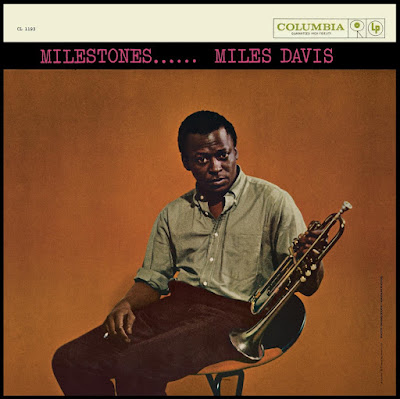
Cover of Milestones. Photograph by Dennis Stock.

Sunday, April 26, 2020

Paul Chambers plays the mambo (sort of)

Paul Chambers in 1958
 by Dennis Stock
Boxed multi-disk sets are wonderful, but they can be a challenge to assimilate. Case in point, the sensational Miles Davis - Gil Evans: The Complete Columbia Studio Recordings, released in 1996. It comprises six CDs full of music that gave us four albums, so you do the math: it contains a lot of music with a lot of repetition.

However, some attentive listening with the appropriate equipment—enough sound on all frequencies, particularly the bass—can unveil treasures such as Paul Chambers's bass line on take 5 of "New Rhumba".

Wednesday, April 15, 2015

Recommended jazz recordings: a list of one


We are smack dab in the middle of Jazz Appreciation Month — pretty meaningless for some of us, but still a nice try at giving exposure to a sophisticated, exciting, and unlikely art form that cuts through class, racial and national considerations. In practical terms, this means events, photo-calls, blurbs, smiling faces... and lists of recordings. Of these we have many, past and present, and they tend to rely more on received wisdom and hype than on critical value — fine if you're OK with "this is great", but not so much if you need "this is great because...".

Besides, there's the wishfulness of recommending more than, say, five records to someone who's not really into jazz at all. With all the incredible stuff around us today, all kinds of music, books, films, TV... either physically or through the internet, an hour of undivided attention has become a luxury.

Because of that, and the fact that recommending anything above five records is an open door to political correctness (of all misconceptions about jazz, the one about its cultivated, unprejudiced listeners is the funniest) and, frankly, a way out for wimps, let's see if I can cut through all that background noise by telling you one (1) jazz album you should have.

It won't be anything by Louis Armstrong, Duke Ellington, Charlie Parker, Miles Davis, or John Coltrane. Those are extraordinary musicians, genres unto themselves, which are not representative of jazz. Say what? No, they're not. Go for any of those by all means, but don't think for a second that the rest of "jazz" is at the same level as the best of their recorded works; bear in mind their excellence and avoid future disappointments. And although many wouldn't admit this, you wouldn't be alone if your first impressions are that Kind of Blue is too slow, or Giant Steps is too overpowering (and don't get me wrong, those are masterpieces).

Sunday, May 26, 2013

The story of "So What"

While we were discussing the convoluted story of the "Rhythm-A-Ning" riff, my worthy constituent Michael 'Jazz Lives' Steinman, purveyor of happiness, said that
certain riffs and variations are "in the air"
which is absolutely true. From outright plagiarism to excessive, but unintentional, "inspiration", these things can happen (I once put together a really pretty set of chords worth of Rachmaninov, so much so that... you get my drift). And it can happen to anyone, even master composer Benny Golson, as he explains to another master composer, Horace Silver, here.

That's all very well, but in American popular music there was ("was", hopefully) laxity when it came to naming the author(s) of a tune. Take Thelonious Monk's "'Round Midnight". How much did Cootie Williams have to do with it, beyond being the first band leader to record it? This is just an example: any unlikely name, from disc-jockey Alan Freed's name on rock'n'roll records, to manager Irving Mills's on Duke Ellington's, it'd be healthy to raise a brow or two.

Another example: Gil Evans only discovered that "Donna Lee" was not Charlie Parker's tune when he asked him about it, to arrange it for Claude Thornhill, and Parker sent him to his  sideman, Miles Davis, who was just 21 at the time.

Friday, September 21, 2012

The Blakey-Chambers duets

On Sunday, March 29, 1959, right between the two sessions that gave us Kind of Blue, the bassist on those, Paul Chambers (age: 23) and veteran drummer Art Blakey (age: 39) seemed to have got early to a recording session led by Sonny Clark.

According to Michael Cuscuna, who unearthed these tapes in the 1970s:
[...] another odd early find in the Blue Note vaults. I was systematically going through every reel of every unissued session. When I put on the first reel of an unissued March 29, 1959 Sonny Clark session, which was ultimately released as My Conception, there was not a piano note to be heard. The first two takes were spectacular performances of "I’ve Got My Love To Keep Me Warm" and "What Is This Thing Called Love" by what could be none other than Paul Chambers and Art Blakey. I never did find out why these came about (perhaps the rest of the band was late), but I’m glad they did.

Glad indeed. If Chambers and Blakey always maintained a very high standard in all their recordings, here, with nowhere to hide, they both give a masterclass in what a rhythm section should be. Without horns, Blakey can afford to be more subtle, which only makes him swing more, not less, as you can hear in "What Is This Thing Called Love?". In this less-is-more vein, Blakey's tour de force is actually, at least to my ears, the slower but still brisk Irving Berlin tune. His versatility with the drum set, or even something so simple-sounding like his playing behind Chambers's opening solo, is mesmerizing.


Available on Mosaic Select: Paul Chambers, and on Art Blakey's Drums Around the Corner