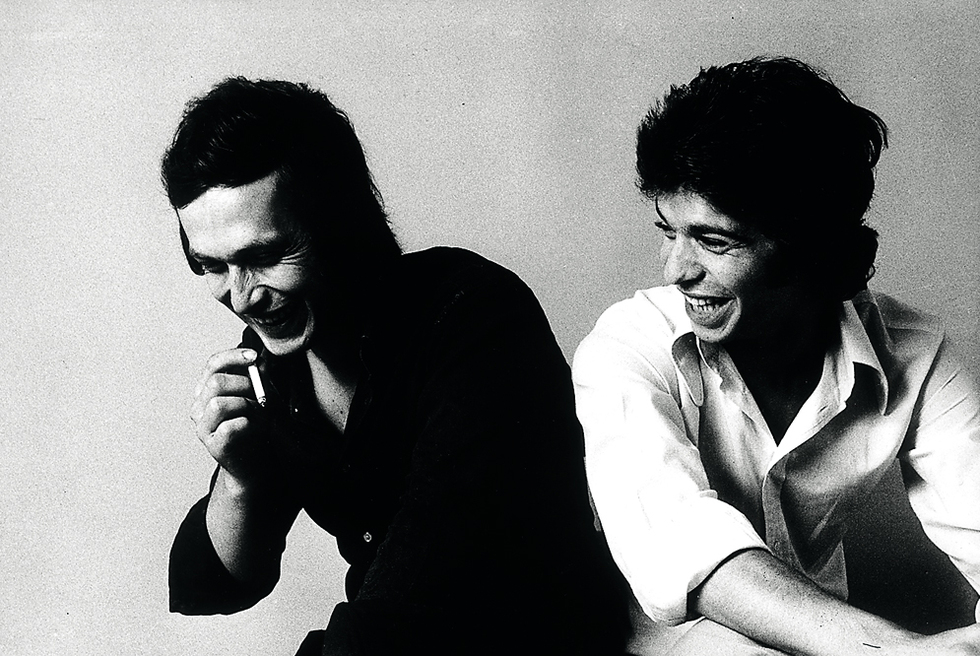
One of the greatest musicians alive today, beyond genres, styles, or categories is Paco de Lucía, born Francisco Sánchez in 1947. Paco is short for Francisco, as people familiar with Spain will know, and Lucía, or, rather, Luzia -she was Portuguese-, was Paco's mother.
De Lucía is a rather retiring person, not really keen on interviews or other promotional activities. For the best part of his career his professional routine has followed this pattern: he takes a few years to prepare a new album, and new means exactly that, new, as in unheard music, tours it, and then he retires to compose for the next one.
Back in 2003, Universal published
Francisco Sánchez, a documentary about the guitarist. That, in itself, was good enough news. But this is more than just that. This is an extraordinary film, it tells De Lucía's story and manages to provide a very intimate portrait of the artist, through interviews with him and others, in a subtle way, never intruding or pushing for anything. About his colleagues, who, without exception, hasten to explain that they're students of De Lucía's, the admiration they show is genuine and moving. Like when his colleague and contemporary, Manolo Sanlúcar says:
Paco is the best instance of what a star is. Listening to Paco, the novice listener will be enchanted, and the expert will go crazy... He's got everything.
However, the real merit of the film is that De Lucía seems to really open up. Besides the brilliant final statement -which I won't reveal here- he says things like:
I don't want to play. I play because I have to. I started playing when i was 12, and I haven't stopped ever since. I've played thousands of concerts and... so many sleepless nights, so much travelling...
De Lucía also explains what he has done with Flamenco music and what his approach is, and is honest enough to admit that he's never had a problem with playing fast (the supernatural coordination between his two hands is possibly the most astonishing feature of his technique). Between him and also Sanlúcar a very clear picture emerges of what being a creative musician entails, and the almost sickening perfectionism that plagues him.

There's plenty of footage of him playing from different eras, including the trio with Al di Meola and John McLaughlin (he explains how he managed to play with them), and also of his daily life, like when he's working on his music with his laptop, or when he's playing with his granddaughter. There are many highlights, like the close-up of
cantaor Camarón de la Isla gobsmacked by De Lucía's playing (see the picture on the left, or the beginning of
this video).
The film was broadcasted recently on Spanish national TV, and now you can watch it online
here.
The DVD edition comes with English and French subtitles, plus a second disc with him playing Rodrigo's
Concierto de Aranjuez and some of his own music.