Showing posts with label guitar. Show all posts

Saturday, October 17, 2020

Sean Levitt, guitar master (1955-2002)

2021-02-03 update: after a couple of comments below by John Lyon, author of Sean Levitt—Seven Transcriptions, which includes the most complete biographical sketch I have seen of Levitt. I have corrected some mistakes, and have only added his complete name and the dates and places of his birth and death. 

~

While jazz lives are routinely thrown to the "tragic" bucket too easily, there are instances for which that label is fitting. Sean Levitt, an astounding jazz guitar player you may have never heard of, is one of those cases.

Sean Levitt in Salamanca, Spain, 1986 (Source)

Wednesday, April 15, 2020

Django's magic

There is very little footage of Django Reinhardt playing (this, go to 2:28, is by far the best available), which makes it difficult to appreciate his dazzling technique. But we can somehow extrapolate.

Django's technique gets even more interesting, given that he only had two fully functioning fingers in his left hand, which was crippled in a fire when he was 19.

(Sources: left / right)

Tuesday, March 26, 2019

The electric Julian Lage

Photo by Nathan West

Julian Lage is one of the great guitar players of his generation. A child prodigy, as documented in Jules at Eight, he stopped being a promise a long time ago. Today, he regularly partakes in a wide variety of projects, but his own trio—with double bass and drums—is the unit where he shines the brightest.

When he last played London, in July 2018, at one point he asked what day it was, not so much because he'd lost track of the calendar—although that's the life of the touring musician—but in appreciation for the audience who'd packed Camden Town's Jazz Café on a Tuesday to hear, as he said, jazz.

Sunday, December 18, 2016

A biography of Oscar Alemán (in Spanish)


Sergio Pujol
Oscar Alemán: La guitarra embrujada
Planeta; Buenos Aires, 2015
Paperback; 312 pp.

The life of Oscar Alemán (1909-1980) is one of those narratives which tend to end up ditched on the kerbs of history. But how do you fit in the jazz canon a black Argentinian guitar player, who got to be hugely popular in pre-WWII France without ever setting foot in the US?

Friday, July 29, 2016

Notes on Charlie Christian's centennial

Today it's the 100th anniversary of Charlie Christian's birthday. For a special 2h30m programme we've done (in Spanish) in El Club de Jazz, I've spent the last few months re-visiting his complete output (except for a very few items, such as Bill Savory's airchecks housed at the National Jazz Museum in Harlem). My playlist tells me that it's 239 tracks longabout 13 hours straightincluding the ones where Christian's presumed to play with Benny Goodman's orchestra. On top of that, I've listened to other guitar players (Bus Etri doing "Flying Home" in 1940, anyone?), plus a generous helping of string music from Texas and Oklahoma also known as Western Swing.

Charlie Christian at the Metronome All-Star session
February 7, 1940. Courtesy of Leo Valdés.

Because it is unavoidable that some of the same old stories will be regurgitated for the centennial, I've jotted down a few notes about CC:

Sunday, May 17, 2015

The King is dead, long live the blues

BB King by Naiel Ibarrola

BB King has died, and it feels like the end of an era. There are artists who seem to have been "always there"; in King's case, he was already playing when my father was a toddler; when he released his first hit, "Three O'Clock Blues", Elvis was 16. He's also the last world-wide known bluesman to have come from the cotton fields of Mississippi, where he was born in 1925. He certainly is the last bandleader to have gone from playing the "chitlin' circuit" to packing the most select venues in the world.

It is the end of an era.

Monday, May 4, 2015

A couple of books about jazz in Spanish

Being one of the most spoken languages in the world, both in terms of people and geography, Spanish has a bibliography about jazz that would need libraries equipped with an ICU. And if we don't take translations into account, one shelf would do. A small one.

That is why it is so newsworthy that we have several new original works about jazz in Spanish, which may interest English-language readers. First of all, history professor and journalist Sergio A. Pujol has just published Oscar Alemán—La guitarra embrujada (Oscar AlemánThe Haunted Guitar, Planeta, Buenos Aires, Argentina), his biography of the great Oscar (stress on the last syllable, /osKAR/) Alemán, which promises to be a great read. Besides the author's proven abilities (he's the author of a history of jazz in Argentina, among other books), his subject, the guitar virtuoso Oscar Alemán (1909-1980) is vital to appreciate how early and far jazz travelled throughout the world (Alemán's heyday was as Josephine Baker's featured star in Paris, France), mainly as music for dancing, when record labels carried the title and the name of the dance that went with the music (like "stomp" or "fox trot").

You can go here for a wide-ranging sample of Alemán's music.

Argentinian paper Página 12 carries an excerpt of the book here.

The publisher's page for this book can be found here.

Some time ago I wrote this about other far and wide travels of jazz in the past.

Monday, March 2, 2015

Steve Brown & Guillermo Bazzola

STEVE BROWN & GUILLERMO BAZZOLA
Una Pequeña Alegría
Brown Cats Productions (BC9508)

Guillermo Bazzola, Steve Brown (g).

Recorded on April 8, 2013. TT: 58:36

This record, "A Little Joy", is the latest by Steve Brown and Guillermo Bazzola, an unlikely duo of pares inter pares (the notes don't state who plays what) for its great gaps in age — rare but irrelevant — and geography: Brown is based in Ithaca, NY, whereas Bazzola lives in Madrid, Spain. Perhaps for this reason this was recorded as in olden times, in one day.

The guitar duo has a long tradition in jazz, but it's a tricky format. There's the sameness in sound, even with imaginative arrangements, and the unavoidable technical pyrotechnics. In this instance, the first notes here are not really promising: both guitars are close in timbre, a rather conventional clean jazz sound, and the tune is a bossa nova, a trap that can be either beautiful or terribly inconsequential.

Although pretty and with a certain weight, like many first tunes at live gigs, the opening "Caminhos Cruzados" (a Jobim song) works well but it's not representative of this record; the other bossa, "Esencia" (by Spanish pianist Alberto Conde) is played with more verve. It is with the second track, "Los Mareados" ("The Dizzy Ones"), where Brown and Bazzola do get down to business. This is an old tango brought to the session by Argentinian Bazzola, and its theme is performed with sensitivity and elegance. This a highlight of the record together with the other tango of the session, "Nada" ("Nothing"), whose beautiful melody is framed by the minute rhythmic nuances, the way the comping guitar falls ever so slightly behind the beat.

Thursday, July 17, 2014

Remembering Johnny Winter

Johnny Winter

"I just hope I’m remembered as a good blues musician."
—Johnny Winter, just a month ago, here.

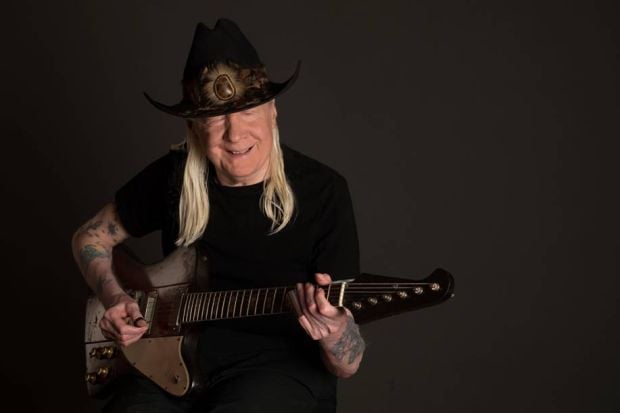
With his mane of white hair and willowy constitution, Johnny Winter was very easy to spot. He was also one of the true electric guitar heroes. He's passed away while on tour in Zurich, Switzerland, on July 16 according to his representative. He was 70.

Given his longevity and visibility, there'll be obituaries everywhere summarizing his life, his ups and downs, and his music. For many, especially the followers of less amplified musics, he could be loud and strident. His mid-1980s LPs, victims to the mastering practices of the time, are a good instance of that brittle, piercing sound. Still exciting blues and rock'n'roll if you ask me. Like so.

Wednesday, May 21, 2014

The "classical" side of Marc Ribot

Guitar proficiency today is just ridiculous, especially with this not-so-new wave of eclecticism, of not restricting oneself to one style of music. People like Bill Frisell, Julian Lage, Nels Cline... are able to jump genres without blinking, whereas others, perhaps more specialized, like Russell Malone, Frank Vignola, John Pizzarelli or Joe Morris and Mary Halvorson are reaching new heights in their art all the time.

All those musicians are just incredible, and you should check them out, either live or on record, and among them a favourite of this blog is Marc Ribot, who turns 60 today.

Ribot has played and recorded as leader and as a sideman, with projects that go from John Zorn's Electric Masada to Alison Krauss & Robert Plant's Raising Sand, or situations like last year's Jazzaldia, where he played with Zorn one day and with Diana Krall on the next. Without being a virtuoso in the conventional sense — although his technique more than serves its purpose — Ribot's taste, touch and indescribably rich, meaty, succulent tone make him a very demanded six-stringer (which helps restore faith in the music scene today, to be frank).

As a child, Ribot was neighbours with noted Haitian guitarist and composer Frantz Casseus, who gave lessons to young Marc. In this article, Ribot talks about his teacher.

Marc Ribot and Frantz Casseus in 1987. Photo by Harriet Ribot.

Monday, March 3, 2014

RIP Francisco Sánchez

Francisco Sánchez, a/k/a Paco de Lucía (picture: ABC)
Francisco Sánchez's passing will leave us without new adventures of Paco de Lucía, the shivers when he appeared on the stage, the ecstasy at the end of a concert. It will divide music lovers between those of us who saw him live and those who didn't. These will have to make do with a sizable amount of recordings and video footage he leaves behind, evidence of the several lives that Francisco Sánchez was able to fit in Paco's: Francisco Sánchez was just 66 when he died, but Paco had been a working musician for over fifty years. So much for Andalusians being lazy and all that.

For me, a child in the Seventies, my first impression of Paco, on TV, was that of a charismatic, handsome, and very serious-looking guy. He had long hair, parted on the side, and although he dressed in a contemporary way, he seemed to follow Seventies fashion from a prudent distance; still in his twenties, he was young too. And he played very fast.

Paco on TVE

Saturday, February 1, 2014

A 60th birthday of rock guitar (possibly)

Fans of any kind of music just love a good discussion on pioneers, on who was the first to do something, and none more so than electric guitar fans. The heroic, macho player, not too different from characters in James Bond or Western movies (guitar slingers, guitar heroes...), lends itself to this kind of speculation.

One such discussion about the first guitar hero recently involved sailing upstream your typical "great man" narrative. Take, say, Eddie Van Halen. Hendrix. That kind of revered, popular guitarist. Jeff Beck. Clapton. Electric wizards with very heavy blues leanings. Creators of new sonic worlds on a fairly new equipment and its complements, of new techniques, new resources, uniquely able to stand in front of tens of thousands mesmerized people. Mike Bloomfield, co-conspirator of Bob Dylan's electrified and electrifying appearance in Newport. And then, circa 1960, the tracks seem to disappear. However, if I had to point to an early example of really outrageous guitar, combining a very early date of recording and release to the public, and ground-breaking playing, my vote would go for a tune recorded 60 years ago today. This one:

(Play as LOUD as possible)


Yep. That is "Space Guitar", a tune Johnny 'Guitar' Watson recorded, two days short of his 19th birthday, on February 1, 1954. It was released the following month as by "Young John Watson" on the Federal label as single #12175 (b/w "Half Pint A-Whiskey").

Wednesday, September 4, 2013

Unexpectedly... Biréli Lagrène

There are records that are not so good, but still hold pleasant surprises. Some are even memorable for just one tiny moment of glory.

One of those would be Jaco Pastorius's Stuttgart Aria. An irregular album, and Jaco's last, it rewards the listener who gets to its very end with Biréli Lagrène's solo on "The Days of Wine and Roses"; Lagrène was just 20 when he recorded it.

Biréli Lagrène is 47 today.


PS: Some years later, Jazzpoint released a double CD, Broadway Blues & Teresa, with music from the Stuttgart Aria sessions, without the keyboard overdubs. In Spotify you can listen to this reading of "Days of Wine and Roses", without synths.

Tuesday, July 16, 2013

The Blues: black, white... and red? (I)

One of the most fascinating aspects in the history of American popular music is the origin of blues music. Having been put at the centre of most of 20th century popular music, the seed of a mass phenomenon such as rock, the contrast with its humble origins in the Mississippi Delta give an epic air to a genre which is already elating and gut-wrenching in itself. If it's also considered as the musical undercurrent of the kidnapping, the trans-Atlantic trip, and slavery of Africans and their descendants in America, myth-making is hard to avoid.

Moreover, on top of this myth a sediment has formed which hardly lets any room for legitimate discussion regarding the origins of this musical genre, a sort of thick dogma compressed by considerations on authenticity. These are always useless, because if we consider history to be a film, authenticity is, at best, just a frame, a random image chosen according to a number of prejudices, selected to be an absolute and non-negotiable model against which the rest of the film is humbly compared. I say at best because normally authenticity isn't even a frame in the film, it's just an idealized utopian past.


Charley Patton - "I Shall Not Be Moved"

In some unproven way, blues is supposed to have been the musical baggage of slaves brought from Africa to America and their descendants. In the beginning, it was just purely a black thing, then it went losing its purity because of white influence of European origin. If we extrapolate that imagined trajectory, the origins of blues would lay in Africa. For a number of reasons, among them the choking and very real presence of racism in the US, the study and debate on what we know as the blues are constrained by some solid barriers. For instance: when it is insisted so much on the black/white racial dichotomy in American music, aren't we forgetting someone?

Friday, July 12, 2013

Party at the Barnes's!!! (part II)

George Barnes
I hope you enjoyed yesterday's video of "Liza", from George Barnes's Guitars Galore album, released in 1961. The beautiful montage was produced by Alexandra Barnes Leh, daughter of George's, who's also producing the George Barnes Legacy collection. This website is not to be missed, especially if you're in the least interested in the history of the guitar in America. Barnes was a true, multi-faceted pioneer, one of those larger-than-life characters, who was gone too soon, in 1977.

At the end of this text you can see some screenshots taken from the video. From the smiling faces, it’s pretty clear that everybody had a ball. Musicians from this era are remembered for their witticisms, their pranks, their humour… their ability to have fun in any given situation. Thanks to Alexandra and her mother, and wife of George's, Evelyn Barnes, we have some details from this actual party. Our deepest gratitude goes to both of them.

Thursday, July 11, 2013

Party at the Barnes's!!! (part I)

This may sound over the top, but I think we will not have a clear idea of how much American popular music of a certain age was soaked in jazz until we have a proper discography (with the names of all musicians involved) of the Columbia and RCA labels, and their subsidiaries. Being those two the biggest labels in the 1950s, it's sort of a wet dream for some of us in all our splendid nerdiness.

Of course music is music, and being able to listen to it should suffice to appreciate all the flavours in it. Still, impressions are affected when you know who's actually playing in whatever record, and it does seem that jazz musicians, or at least musicians with a heavy jazz slant, or big band veterans whose early days were spent playing music with a high jazz-octanage, were everywhere in American popular music from the 50s and 60s. And it's not just Sinatra's albums featuring members of the Stan Kenton ot the Count Basie orchestras. There's much more.

Tuesday, February 5, 2013

Musicians' quotes: Marc Ribot on technique

I don’t want to impose some agenda on a song. I respect the ability to read the song, to figure out the song’s intentions. Chops need to be in the service of meaning. People who don’t get that are… dumb.

Marc Ribot in a double interview with Nels Cline
by Jim Macnie for the July 2011 issue of DownBeat magazine


Marc Ribot - guitar
Henry Grimes - bass
Chad Taylor - drums

Sunday, January 27, 2013

Django!

On January 23 I marked Django's birthday with an impromptu, off-the-cuff selection of his recordings, and I posted it on Twitter. His guitar was one my early hooks in jazz, and his recordings remain special.

So, without further ado, I give you my Django!. Recordings date from the mid-30s to 1953; if you hear a violin, it's Stéphane Grappelli. If there's a clarinet that'll probably be Hubert Rostaing, same goes for Alix Combelle and his tenor sax (on "Finesse" Rex Stewart is on cornet and Barney Bigard on clarinet). Depending on the date, Django's instrument maybe an acoustic guitar, an electrified acoustic, or a electric guitar proper.

Enjoy the music on YouTube or Qobuz!

* LES YEUX NOIRS


Friday, December 21, 2012

Review: Charlie Christian Genius boxed set

(This is a translation of my review for Cuadernos de Jazz)


Charlie Christian: The Genius of the Electric Guitar
(4-CD set, Sony/Legacy 88697930352; released in 2012)

Charlie Christian (el-g) with, among others, Benny Goodman (cl), Lionel Hampton (vib), Cootie Williams (tp), George Auld, Lester Young (ts); Johnny Guarnieri, Count Basie (p); Artie Bernstein (b), Nick Fatool, Dave Tough, Jo Jones (d).

Recorded in New York and Hollywood, between 1939 and 1941.

When it comes to jazz, the recording industry, whatever's left of it, lives on reissues. These are cheap to produce, whether for the legal owners of the masters, or whoever chooses to shield themselves behind EU law. Poor little us are left, in the meantime, with a mess of sets to be checked for price, sound quality and track titles to avoid duplication or just hoarding more stuff. A true nightmare.

Sunday, July 15, 2012

An unsigned artist in Gioia's The Jazz Standards

Ted Gioia has just published his latest book, The Jazz Standards - A Guide to the Repertoire (Oxford University Press). Gioia has a strong reputation as a writer on jazz, and this book, on a subject that deserves this kind of work, will widely read (at least as widely as this kind of book is normally read).

A nice surprise in the book is the inclusion of this version of "My One and Only Love", which is only available as a home recording on YouTube, made and uploaded by the artist herself:


Susana Raya is a singer-guitarist from Córdoba (Spain), and has just finished her jazz guitar degree in Amsterdam. For Spanish readers, this interview from 2009 seems to portray her well. She appears as a sensitive and sensible musician, who's been hooked to the guitar since she was a kid. She studied classical guitar back in Spain, did a degree in business, but then decided that music is her life. She moved to Amsterdam to study, and she lives there at the moment. 

Admittedly, Gioia's mention is short, setting Susana's take as an example of the possibilities that "My One and Only Love" still offers after so many years. In any case, she's now in a serious book, sharing a list with Charlie Ventura, Art Tatum & Ben Webster, John Coltrane & Johnny Hartman, Sonny Rollins, Chick Corea, McCoy Tyner, Michael Brecker, Cassandra Wilson, Joshua Redman, Sting, Mark Murphy and Kurt Elling. Not bad at all. 

The fact that such an "important" writer as Gioia has acknowledged a "nobody" like Susana in such a way, is a good example of honest musical criticism, independent from aspects such as fame, name, prestige, career, etc. Writers, including myself, and promoters too, should take good note of this in order to avoid distractions and trust our ears more.