Showing posts with label books. Show all posts

Saturday, August 29, 2020

Sunday, December 18, 2016

A biography of Oscar Alemán (in Spanish)


Sergio Pujol
Oscar Alemán: La guitarra embrujada
Planeta; Buenos Aires, 2015
Paperback; 312 pp.

The life of Oscar Alemán (1909-1980) is one of those narratives which tend to end up ditched on the kerbs of history. But how do you fit in the jazz canon a black Argentinian guitar player, who got to be hugely popular in pre-WWII France without ever setting foot in the US?

Monday, May 4, 2015

A couple of books about jazz in Spanish

Being one of the most spoken languages in the world, both in terms of people and geography, Spanish has a bibliography about jazz that would need libraries equipped with an ICU. And if we don't take translations into account, one shelf would do. A small one.

That is why it is so newsworthy that we have several new original works about jazz in Spanish, which may interest English-language readers. First of all, history professor and journalist Sergio A. Pujol has just published Oscar Alemán—La guitarra embrujada (Oscar AlemánThe Haunted Guitar, Planeta, Buenos Aires, Argentina), his biography of the great Oscar (stress on the last syllable, /osKAR/) Alemán, which promises to be a great read. Besides the author's proven abilities (he's the author of a history of jazz in Argentina, among other books), his subject, the guitar virtuoso Oscar Alemán (1909-1980) is vital to appreciate how early and far jazz travelled throughout the world (Alemán's heyday was as Josephine Baker's featured star in Paris, France), mainly as music for dancing, when record labels carried the title and the name of the dance that went with the music (like "stomp" or "fox trot").

You can go here for a wide-ranging sample of Alemán's music.

Argentinian paper Página 12 carries an excerpt of the book here.

The publisher's page for this book can be found here.

Some time ago I wrote this about other far and wide travels of jazz in the past.

Friday, January 16, 2015

Chicago, 1941, the blues (but no Earl Hines)

While browsing a recently, and lavishly, published book about a historical jazz record label, I saw this picture:

Source Shorpy.com
In the book the picture comes cropped and tilted, and the caption reads "Earl Hines at the mic during a gig in Chicago, April 1941". But that's not Earl Hines. Not even close.

Shorpy.com, where I found this version of the image, carries this caption: April 1941. "Tavern on the South Side of Chicago, Illinois." Acetate negative by Russell Lee for the Farm Security Administration. Interestingly, in the comments section someone says "looks like bandleader and pianist Earl Hines is at the mike". Oh, well...

Friday, December 19, 2014

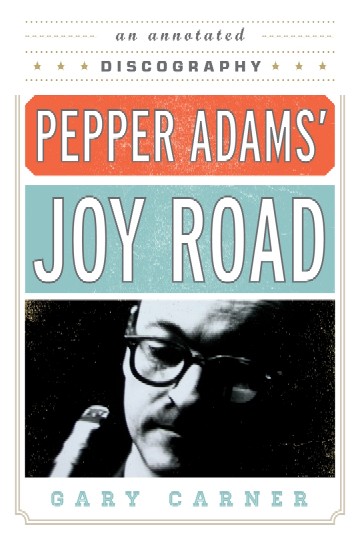
Books: Pepper Adams (& Gigi Gryce)

Listen to the opening notes of this tune:


That is one of the most widely heard jazz sounds ever, even though many wouldn't know that they're actually listening to Pepper Adams, a giant of the baritone sax who blasts through the whole piece playing that vamp almost constantly. Now we also know how grinding this session was for him, because the musicians in this Mingus band had never played together until that day in the studio, and there was a lot of repetition and many false starts involved in the recording.

That is the kind of detailed, first-hand information you can read on Gary Carner's Pepper Adams' Joy Road - An Annotated Discography (Scarecrow Press, 2012), a true labour of love by the author, who's been justly awarded with the 2013 award to the best jazz discography by the Association of Recorded Sound Collections, ARSC.


Friday, May 9, 2014

RIP Joe Wilder (1922-2014)

Joe Wilder at IJS
(Photo by Ed Berger)
Ed Berger, his good friend and biographer, reports the passing of Joe Wilder earlier today. Wilder, somehow like Hank Jones, was a gentleman, a dedicated craftsman in his instrument, from which he extracted the most beautiful sound, soft yet slightly brassy. With him gone, yet another window to the past is closed, but at least we have Berger's biography, which is already available. And we'll always have the records.

This is an article about Wilder by Berger. Here, he's at Marian McPartland's Piano Jazz on NPR.

This is Wilder taming an old warhorse.


Monday, February 17, 2014

ND — Carlos Montoya: From St. Louis to Seville (and a book...)

Carlos Montoya: From St. Louis to Seville
(RCA/Victor LPM-1986)

This new entry in the infrequent series Notes on discography (ND) is about an early experiment in jazz-flamenco fusion. From St. Louis to Seville is an album by Carlos Montoya published in 1959, at a time when the recording business was booming partly thanks to the mass introduction of stereo and hi-fi, flamenco had began to be well known in the US, and jazz was going through a sweet spot in its history. The significance of this LP is more historical than musical, given the context of both flamenco (think Sabicas) or jazz at the time, or even the meeting of jazz and Spanish music arranged by Miles Davis and Gil Evans about a year later in their Sketches of Spain.

Wednesday, September 11, 2013

Benny Goodman at Carnegie Hall: new reissue, still incomplete

Benny Goodman at Carnegie Hall 1938 is an iconic record. It has been in print since 1950, and it offers a great snapshot of Swing at his height, not only musically but socially. However, to this day we don't have a complete issue of the music, as I explained in this previous post.

There's a new reissue just out—Benny Goodman at Carnegie Hall 1938, Sony Music Entertainment (Japan) Inc., Blu-spec CD2 SICP 30223-4. This has been released in the new Blu-spec CD2 format, but it's based on the previous official CD master (C2K 65143, from 1999), and therefore it's still missing half a minute of music, although the sound seems to have gained definition.

Thursday, July 18, 2013

The Blues: black, white... and red? (and III)

With today's text we reach the end of the excerpt first published on line by UTNE Reader from The Guitar and the New World, the new book by Joe Gioia. Once again, our thanks go to the author and the publisher, SUNY Press. If the earlier parts (the first and the second) sound interesting enough, the rest of the chapter “Hey-Hey” digs wider and deeper into some of the points made so far.

As it has happened with some of the books mentioned by Gioia in the second part (especially Hamilton's), his may be difficult to accept for its ground-breaking view of the origins of the blues, a unique genre about which people have been capable of keeping a straight face while talking of deals with the devil. On the other hand, Gioia's book may well go through the same heavy revisions as Charters's and Oliver's books in the future. Even in that case, the oversight Native Americans have suffered in this whole story of the music of North America is so enormous, that what's really important in Gioia's discourse is not so much whether his answers are correct, but the questions he asks; not what he's found, but the fact that he's pointing his torch in a different and hardly explored direction.

At "worst", the book can also be used as the author's guide to North-American music from the first half of the 20th century. Although some tracks may seem out of place without the book at hand, almost all the songs he mentions are included, in order of appearance, in this Spotify playlist (the links in the text lead to YouTube).

Back to the text: Having argued that there is sufficient reason to consider seriously the role of Native Americans in the origins of the blues and other musics from the US, the author keeps following that trail, and he begins to find some clues...

Wednesday, July 17, 2013

The Blues: black, white... and red? (II)

Second part of the excerpt from the chapter entitled "Hey, Hey", taken from Joe Gioia's The Guitar and the New World. In the previous part the author pointed out the two early 20th century seminal accounts from which all blues historiography emanates, Charles Peabody's and W. C. Handy's, and how from there its origins have been linked to slavery or even to Africa without any solid evidence to prove it.

Thanks to Joe Gioia and his publisher for granting permission for me to translate this text and publish it here. The complete excerpt is readily available on line at the UTNE Reader website.

Tuesday, July 16, 2013

The Blues: black, white... and red? (I)

One of the most fascinating aspects in the history of American popular music is the origin of blues music. Having been put at the centre of most of 20th century popular music, the seed of a mass phenomenon such as rock, the contrast with its humble origins in the Mississippi Delta give an epic air to a genre which is already elating and gut-wrenching in itself. If it's also considered as the musical undercurrent of the kidnapping, the trans-Atlantic trip, and slavery of Africans and their descendants in America, myth-making is hard to avoid.

Moreover, on top of this myth a sediment has formed which hardly lets any room for legitimate discussion regarding the origins of this musical genre, a sort of thick dogma compressed by considerations on authenticity. These are always useless, because if we consider history to be a film, authenticity is, at best, just a frame, a random image chosen according to a number of prejudices, selected to be an absolute and non-negotiable model against which the rest of the film is humbly compared. I say at best because normally authenticity isn't even a frame in the film, it's just an idealized utopian past.


Charley Patton - "I Shall Not Be Moved"

In some unproven way, blues is supposed to have been the musical baggage of slaves brought from Africa to America and their descendants. In the beginning, it was just purely a black thing, then it went losing its purity because of white influence of European origin. If we extrapolate that imagined trajectory, the origins of blues would lay in Africa. For a number of reasons, among them the choking and very real presence of racism in the US, the study and debate on what we know as the blues are constrained by some solid barriers. For instance: when it is insisted so much on the black/white racial dichotomy in American music, aren't we forgetting someone?

Wednesday, May 15, 2013

SALT PEANUTS!!! SALT PEANUTS!!! – Massey Hall, 60 years after

Bud Powell, Charles Mingus, Max Roach, Dizzy Gillespie, Charlie Parker
Massey Hall, Toronto, May 15, 1953
Photo by Harold Robinson

Sixty years ago today, at about 20:30, Toronto time, everything was ready for a historical evening. The best quintet in history, reuniting the founder fathers of bebop, a bunch of jazz revolutionaries, were going to play together in a summit meeting of music. This is the infamous night when a plastic sax had to be borrowed for Charlie Parker, because he hadn't brought his instrument. The night when he and his former soulmate, Dizzy Gillespie, exchanged musical punches. The night of Bud Powell's first appearance after his release from hospital.

You probably knew that. Every jazz fan knows that. However, half of the paragraph above is untrue. Of course, we've read that story many times, and it's very likely that we will read it again. But it is essentially false. Untrue. Even so, it's a story that has been repeated over and over again in the media, either general or specialized, in Spanish and in English.

Wednesday, December 12, 2012

Sinatra's world tour, 1962

Today Frank Sinatra would have been 97. I've been checking out videos here and there, and have found the one below from his 1962 tour, which he did accompanied by a sextet, based on Red Norvo's, with whom he had toured previously (Norvo was unavailable for this one), which gives a lighter, jazzier feel to the music.

But first, a couple of excerpts from Will Friedwald's indispensable tome The Song is You (Da Capo, New York, 1997).

Sunday, July 15, 2012

An unsigned artist in Gioia's The Jazz Standards

Ted Gioia has just published his latest book, The Jazz Standards - A Guide to the Repertoire (Oxford University Press). Gioia has a strong reputation as a writer on jazz, and this book, on a subject that deserves this kind of work, will widely read (at least as widely as this kind of book is normally read).

A nice surprise in the book is the inclusion of this version of "My One and Only Love", which is only available as a home recording on YouTube, made and uploaded by the artist herself:


Susana Raya is a singer-guitarist from Córdoba (Spain), and has just finished her jazz guitar degree in Amsterdam. For Spanish readers, this interview from 2009 seems to portray her well. She appears as a sensitive and sensible musician, who's been hooked to the guitar since she was a kid. She studied classical guitar back in Spain, did a degree in business, but then decided that music is her life. She moved to Amsterdam to study, and she lives there at the moment. 

Admittedly, Gioia's mention is short, setting Susana's take as an example of the possibilities that "My One and Only Love" still offers after so many years. In any case, she's now in a serious book, sharing a list with Charlie Ventura, Art Tatum & Ben Webster, John Coltrane & Johnny Hartman, Sonny Rollins, Chick Corea, McCoy Tyner, Michael Brecker, Cassandra Wilson, Joshua Redman, Sting, Mark Murphy and Kurt Elling. Not bad at all. 

The fact that such an "important" writer as Gioia has acknowledged a "nobody" like Susana in such a way, is a good example of honest musical criticism, independent from aspects such as fame, name, prestige, career, etc. Writers, including myself, and promoters too, should take good note of this in order to avoid distractions and trust our ears more.

Thursday, June 16, 2011

Musicians' quotes: Tristano on the ego, the id, and jazz

In 1964, when asked what he thought of [John] Coltrane, [Sonny] Rollins, and [Miles] Davis, Tristano answered, "All emotion, no feeling." He replied to "How do you distinguish between the two?" with: "Well, say I believe there is no real hysteria or hostility in jazz, their stuff is the expression of the ego. I want jazz to flow out of the id. Putting it another way, real jazz is what you can play before you are all screwed up; the other happens after you're screwed up."

(Ira Gitler, Masters of Bebop,
a re-print of Jazz Masters of the '40s, Da Capo, 2001, p. 243)

Monday, June 13, 2011

Tristano's method

Saxophonist Ted Brown, a former student of Lennie Tristano, explains the main points of Tristano's approach to teaching jazz.


For more on Tristano's method and the teaching of jazz in general, the relevant chapter on Eunmi Shim's biography is mandatory.

Around 2007 we suddenly had three volumes about Tristano, each of them with their own approach to Tristano and each of them pretty much mandatory. Eunmi Shim's is a scholarly biography, with excellent chapters about the music and Tristano's teaching methods, Peter Ind's is a passionate and atmospheric first-hand account of his experiences with Tristano, and Fayenz & Brazzale's, in Italian and including a CD with recordings from 1945-55, is a concise and to the point introduction to Tristano as a person and as a musician.

That year I did a long article with reviews and extracts from those three books, which you can now read, in Spanish, on line at Cuadernos de Jazz.

Monday, April 18, 2011

Quotes from Heroes and Villains

Heroes and Villains is a collection of articles by David Hajdu, best known in the jazz world for his biography of Billy Strayhorn. However, the scope of his writing is much wider than that, with room for people as diverse as Philip Glass, John Zorn, Beyoncé, and The White Stripes, or comic book authors like Will Eisner or Joe Sacco. I got a copy of this 2009 book only yesterday, and just some random browsing is proving promising. So far I'd say his main strength is the way he develops his articles: The endings of the chapter on Richard Rodgers and of the second act of "A Hundred Years of Blues" are as relevant as they are shocking and as real as your own life.

He also has the ability to choose meaty quotes like these:

"A lot of white fans remind me of the idiot who goes to the opera house to listen to the orchestra" (Delmark Records' Bob Koester on the guitar fetichism of white blues fans.)

"Talent is like the battery in the car. It'll get you started, but if the generator is bad, you don't go very far" (Ellis Marsalis);

or to talk at length about this picture

© Life

and describe so vividly the drama behind the innocent fun everyone in it is having, due to its role in the demise of Billy Eckstine's career, that he makes the reader run to the computer to find the image and check for ourselves the power of racial prejudice in America, in 1950.