Showing posts with label quotes. Show all posts

Wednesday, August 29, 2018

Bird quotes Satchmo

When Charlie Parker and Dizzy Gillespie burst into the jazz scene in the mid-1940s, much was made of the presumed animosity between the new and the older generations of musicians. Although there were some noises in that direction, let's just say that jazz journalism paid too much attention to celebrity status, fans and gossip.

Back in 1928, Louis Armstrong recorded this classic cadenza as the opening for his "West End Blues":


Charlie Parker must have been listening, since he used it twenty years after Armstrong, at least twice on record, both times while playing the blues, one at Carnegie Hall on Christmas day, 1949:


the other at St. Nicholas Arena in New York (St. Nick's), a couple of months later:


PS 2022-03-25: And a third one, on May 30, 1953, at Birdland with Bud Powell on piano and Charles Mingus on bass.

Monday, September 29, 2014

Paul Desmond on Ornette...

Paul Desmond (1965)
It wouldn't be easy to find two more opposed alto saxophonists in the history of jazz than Paul Desmond and Ornette Coleman. Besides playing the same instrument and having American passports, the rest couldn't be more different. For fans, it seems that today it is more politically correct saying that we like Ornette better than Desmond, but the fact is that Desmond is probably the more popular of the two. Never mind that, anyway, both deserve your listening time for very different reasons, trust me.

In a quite funny collection of Desmond's aphorisms, or "desmondisms", there's a quote of his talking about Ornette's music. No source is mentioned, and it goes like this:

It's like living in a house where everything's painted red.

Monday, February 10, 2014

Jazz is... / Jazz is not...


That is the last paragraph of Martin Williams's review of the film I Want to Live (IMDB, Wiki), published on The Jazz Review (May 1959, p. 39).

This and other issues of The Jazz Review, a short-lived but groundbreaking magazine, can be read at the Jazz Studies Online website. You can download a PDF of the issue above, here.

Sunday, November 4, 2012

Peter Brötzmann and... Lionel Hampton

German saxophonist Peter Brötzmann (b. 1941), one of those guys who could make you a straight soprano sax by blowing on a curved one, is one of the stalwarts of European free improvisation. He came up at the end of the 1960s and, while he might be expected to have drawn inspiration for similarly-minded American players, this is what he says about the his seminal, groundbreaking, even violent Machine Gun (1968) and his unlikely model.
"I wanted to sound like four tenor saxophonists, that's the sound that I wanted... I got the idea from the Lionel Hampton band, the big band he had, with four really heavy saxophonists in the front line and they played unison. That's the sound I've been trying to get, that's what I was attempting with Machine Gun and that's what I'm still chasing"
Peter Brötzmann, interviewed in the November issue of Wire magazine.

Brötzmann will be, with his Chicago Tentet at London's Cafe Oto on November 9-10, as part of the London Jazz Festival.

Lionel Hampton: "Flying Home" (1967)


Peter Brötzmann: "Machine Gun" (1968)


Monday, July 23, 2012

Jazz according to Branford Marsalis (and Blakey)

... one time [Ben Sidran] interviewed Art Blakey, and he said "if you had to describe jazz in one word, what would it be?" And Art said the same word three times. He said: "Intensity. Intensity. Intensity. Even on the ballads"... So, even if you have people who won't know what we're doing, they'll feel what we're doing.
From the video below, as seen on Doug Ramsey's Rifftides blog.
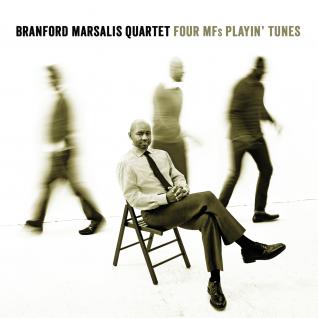
Branford Marsalis Quartet's new album, Four MFs Playin' Tunes, is out now.


Monday, July 2, 2012

Other quotes (IV): Xabi Alonso

Which jazz musicians do you enjoy?

I've seen bands playing here [in Madrid], at Populart or Café Central, but I've listened more to people  [my brother] Mikel introduced me to, the classics: Chet Baker, Duke Ellington, Louis Armstrong... When he became interested I'd also listen to whatever he played...

Xabi Alonso (Real Madrid, Spanish national team), interviewed by Íñigo Gurruchaga for JotDown magazine (special hard copy issue).

Thursday, June 28, 2012

Musicians' quotes: Max Roach on historical perspective

Some of the records were done 'under the table', because you were fined and thrown out of the union if you did record. It was always a hustle and a rush. Much of the music written by Charlie Parker was written in taxi cabs on the way to the studio [...] It was get in, get out immediately, because the union was always lurking around the corner. And it's amazing to me, when I remember how it was done, how today it is considered so profound.

Max Roach on the sessions recorded during the 1948 Musician's Union ban, which include Charlie Parker's "Parker's Mood", quoted on Geoffrey Haydon's Quintet of the Year (Aurum Press, 2002).


Thursday, June 14, 2012

Other quotes (III): Ray Bradbury


Federico Fellini [...] said "Don't tell me what I'm doing, I don't want to know" 
~~~~~
I didn't know what I was doing, but I'm glad that it was done.

Ray Bradbury, on his disregard for the "secret motives" within his writing, in the introduction to the 50th anniversary edition of Fahrenheit 451
(HarperVoyager, 2008)

Saturday, June 2, 2012

Other quotes (II): Pío Baroja

Spanish writer Pío Baroja (1872-1956), asked by a journalist about literature, circa 1918, also talks about music: 
[Works that look old, too touched up] are the ones which provoke enthusiasm in audiences. It happens in literature as well as in music - generally, unless the listener recalls the melody they will not like the work. Summing up will always be successful, because its context is already there [...] This kind of summing-up works may have some new elements, but the fewer new elements in them, the better they're liked by the audience.
Soon after he places himself within the audience.
Waltzes have always been very suggestive to me. Even though they're so worn down, so overused, they still affect me.
Pío Baroja, Las Horas Solitarias
(Ediciones 98, Madrid 2011, pp. 330 y 333)

Saturday, May 26, 2012

Musicians' quotes: Levon Helm on music

"We try and play to a tradition. Music is not a fad, and music ain't a style, and it ain't none of that stuff that it has to serve. Music ain't theater... you can make music do lots of things because music don't care."
Levon Helm, who would have been 72 today, interviewed in 1984.


 THE BAND

Richard Manuel: piano and vocals
Rick Danko: bass and vocals
Garth Hudson: organ and keyboards
Robbie Robertson: guitar
Levon Helm: drums and vocals

 with

 Snooky Young: trumpet
Earl McIntyre: trombone
JD Parran: alto sax
Joe Farrell: tenor sax
Howard Johnson: baritone sax

 At Academy of Music, New York,
New Years' Eve, 1971.

Tuesday, May 8, 2012

Musicians' quotes: on influences and honesty

You have to do what comes honestly to you. You're just a sum of your influences. You drink it in, then you spit it back out, and you have to be honest about what comes out.
Rich Hope interviewed on Spain's Radio 3 (39:48).

Monday, October 3, 2011

Musicians' quotes

Basically, I don't care what category music belongs to; I only care whether it is good or bad. As one fellow musician put it: "I like jazz, not because it's jazz, but because it's good music."

Gunther Schuller: Musings
(Da Capo, 1999; p.115)


Sunday, September 4, 2011

Musicians' quotes: Milt Buckner on jazz

"It must have a beat and it's got to have soul"
(Milt Buckner on jazz)


Thursday, June 16, 2011

Musicians' quotes: Tristano on the ego, the id, and jazz

In 1964, when asked what he thought of [John] Coltrane, [Sonny] Rollins, and [Miles] Davis, Tristano answered, "All emotion, no feeling." He replied to "How do you distinguish between the two?" with: "Well, say I believe there is no real hysteria or hostility in jazz, their stuff is the expression of the ego. I want jazz to flow out of the id. Putting it another way, real jazz is what you can play before you are all screwed up; the other happens after you're screwed up."

(Ira Gitler, Masters of Bebop,
a re-print of Jazz Masters of the '40s, Da Capo, 2001, p. 243)