Showing posts with label photography. Show all posts

Friday, December 15, 2023

Miles Ahead in images

Some time ago, I put together Dennis Stock's photos from the first session for Miles Davis's Milestones record.

We now turn to one of the sessions for Miles Ahead, the first Miles Davis/Gil Evans collaboration for Columbia, a relevant LP in Miles Davis's career for its commercial success (the infamous change of covers was made easier by the speed at which runs of prints sold out). The photographs were taken in May 1957 at Columbia's studio on 30th St, Manhattan, and they come from Miles Davis's official website, where they do not carry information on location, date or personnel. From the credits in the Complete Miles/Evans Sony set, we know they were taken by Don Hunstein, Columbia's staff photographer.

Second and final LP cover (source)

The most significant image is the one showing the ensemble (except bass and drums), because it shows the positions of musicians and microphones (a grand total of four were used) to record an orchestra out of balance between the brass (one microphone in the middle for five trumpets, four trombones, two French horns and one tuba) and the "reeds" (one microphone for four chairs sharing alto sax/clarinets/flutes/oboe). As the (almost) only soloist, Davis has his own microphone, and I guess the fourth was for bass and drums, out of frame (click on the images to enlarge them).

Friday, November 10, 2023

Charlie Parker and Chet Baker 70 years ago

In late October of 1953, about 70 years ago, producer Gene Norman—he of the label GNP/Crescendo—organized a mini-tour of the West Coast with two bands. The header was the Dave Brubeck Quartet, with Brubeck on piano, Paul Desmond on alto sax, Ron Crotty on bass, and Lloyd Davis on drums—1953 was a significant year for Brubeck: the quartet recorded Jazz at Oberlin on March 2 and Jazz at College of the Pacific on December 14, a month after that mini-tour.

The other band in the bill was a Charlie Parker quintet with Chet Baker on trumpet, Jimmy Rowles on piano, Carson Smith on bass, and Shelly Manne on drums (Parker and Baker had met the year before in California). As for Parker, on May 15 he had taken part in the famous "Quintet of the Year" concert at Massey Hall in Toronto, and in the second half of the year he would play at the Open Door in New York City, the location of some spectacular recordings and some well-known photographs by Bob Parent.

According to Leif Bo Petersen's chronology, the dates of that tour were as follows:

    October 30: Olympia, WA
    October 31: Seattle, WA
    November 1: Portland, OR
    November 2: Vancouver, BC, Canada
    November 4: Eugene, OR
    November 7: Hollywood, CA
    November 8: San Diego, CA

In Portland, OR, they were snapped by local photographer Carl Henniger:

Carson Smith and Charlie Parker

Tuesday, August 8, 2023

Steve McQueen's vinyl collection

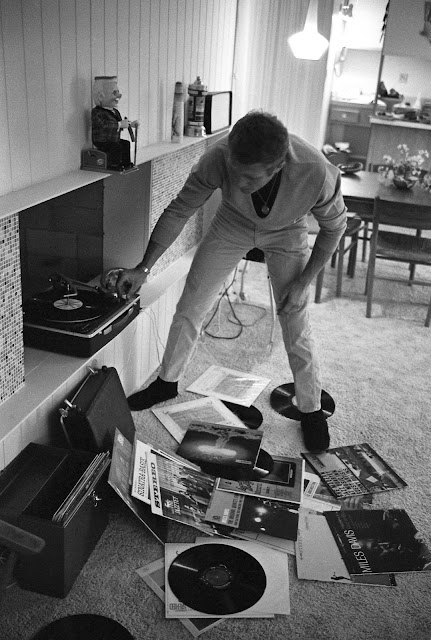
His ability as an actor aside, Steve McQueen was a photogenic man, as proved by the work of photographers like William Claxton and John Dominis. The latter, who's been featured in this blog before, took this image below, which may be familiar to music lovers.

Steve McQueen in 1963 by John Dominis
©John Dominis/Time & Life Pictures/Getty Images
(source)

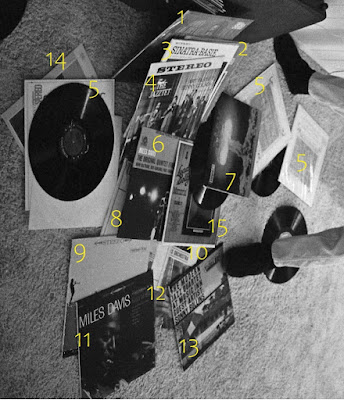
If you're reading this, you've probably wondered what are those LPs spread all over Mr. McQueen's floor (we want to believe he's not stepping on one of them). If that's the case, I think I have been able to identify all the sleeves, even those only partially visible.

The two immediate conclusions are, firstly, that McQueen must have had some direct or indirect contact at Atlantic Records: not only is the label with most LPs in the room, but there seem to be up to three copies of one album.

Secondly, this collection of LPs, mostly stereo, is of its time. Even though LPs recorded and published in the mid-1950s could already considered to be high-fidelity soundwise, from about 1957 recordings are made also in stereo—often in paralel to mono—and towards the end of that decade stereo sound becomes the norm, with the popularity of hi-fi.

Given the rising tide of hi-fi equipment, record labels on the one hand phased out mono sound, and on the other they adapted their existing and still recent mono stock to the new stereo sound, through processes of "remastering" or "rechanneling", which at times didn't amount to much more than playing the same music through both left and right channels with minor differences in equalization or phase in order to give the listener a sense of space, of "stereo". This is the case with at least two of the LPs in the list below, numbers "6" and "14". The rest are LPs published in stereo, except for two instances of mono issues.

I've numbered the LPs in the image below. I've also added links to Qobuz (for audio) and Discogs (for info on the LPs).

Finally, it is quite clear that Mr. McQueen had excellent taste, or he knew how to be advised on musical matters.


(Click on the image to enlarge it)

Friday, February 4, 2022

Miles Davis: February 4th, 1958—in pictures

On Tuesday, February 4th, 1958, at Columbia Records' studio on Manhattan's 30th St., a session was booked for the afternoon. It lasted from 2 to 6.30 pm, with Harry "Chappy" Chapman, an in-house veteran going back to the early 1940s, manning the control room. 

The musicians and producer involved may have not known it at the time, but this was to be the first of two momentous occasions: this session and the following one, on March 4, were to be the last produced for Miles Davis by George Avakian, who had put him in the map by signing him to Columbia, the label he ended up staying with for thirty years, between 1955 and 1985. 

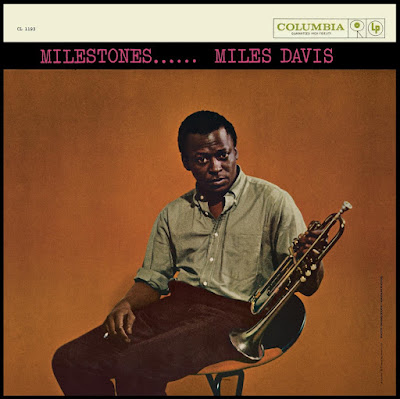
These sessions on February and March 4 would also be the last ones by Davis's "first quintet", with Red Garland on piano and "Philly" Joe Jones on drums. Together, they'd form Milestones, a, er, milestone in Miles Davis's career, which may have seemed unsurpassable at the time. Not for long, though: his next small group album would be Kind of Blue.

Cover of Milestones. Photograph by Dennis Stock.

Saturday, May 8, 2021

Bud Powell with the 'Birth of the Cool' nonet

Bud Powell at Birdland

One the many discoveries made by Peter Pullman in his definitive biography of Bud Powell is that the pianist sat in once with Miles Davis's short-lived Nonet, of "Birth of the Cool" fame. 

We know the regular pianist was John Lewis, who also contributed a number of arrangements ("Move", "Budo", "Why Do I Love You") and compositions ("Rouge", "S'il Vous Plaît") and is present in all the recordings except the first studio session, where he was replaced by Al Haig. 

According to Pullman, Powell's sitting in took place some time in 1950 at Birdland. In his book (pp. 138-139) he quotes extensively from budding pianist Sy Johnson, then just about 20 years old and living in Connecticut, for whom the trip to New York City to see and listen the Miles Davis Nonet (and the Lennie Tristano Sextet) must have been a special occasion, even though it wasn't remembered by any of the musicians Johnson spoke to years later.

Friday, June 26, 2020

Cecil Taylor dances to...

Passion for music is one facet common to both its practitioners and their audiences. If not passion, at least its overbearing presence in our daily lives. In jazz, with so many giant innovators and because its history has often been told as a relay race where the baton would be "influence", there has always been some interest in knowing what our idols listen(ed) to. We know that Miles Davis would listen to anything, including a lot of jazz —as shown in his various blindfold tests— or that Coleman Hawkins hardly listened to any other music than classical at home.

One of those giant innovators would be Cecil Taylor. Admittedly, not everyone's cup of tea, but I think we can agree that he was a monster pianist with an unassailable artistic and personal integrity.

Roaming around the internet, I have found these two photographs, taken by Deborah Feingold:

(Source)

(Source)

Taylor seems to be dancing—which he would do in his performances—in his music room, where besides the piano and a conga drum (under his right arm), there can be seen a lot of LPs, among which three covers can be made out.

Wednesday, June 5, 2019

Roy Eldridge's photographs: pulling a thread

Back in 2013, in the aftermath of Hurricane Sandy, the saga of trumpeter Roy Eldridge's earthly possessions came to light. All may have seem to be lost, but only a few days ago it was announced that the University of North Texas Music Library had "finished digitization and metadata for almost 700 photos, newspaper clippings, date books, and other documents in the Roy Eldridge Collection belonging to the Sherman (Texas) Jazz Museum." This collection can now be seen here.

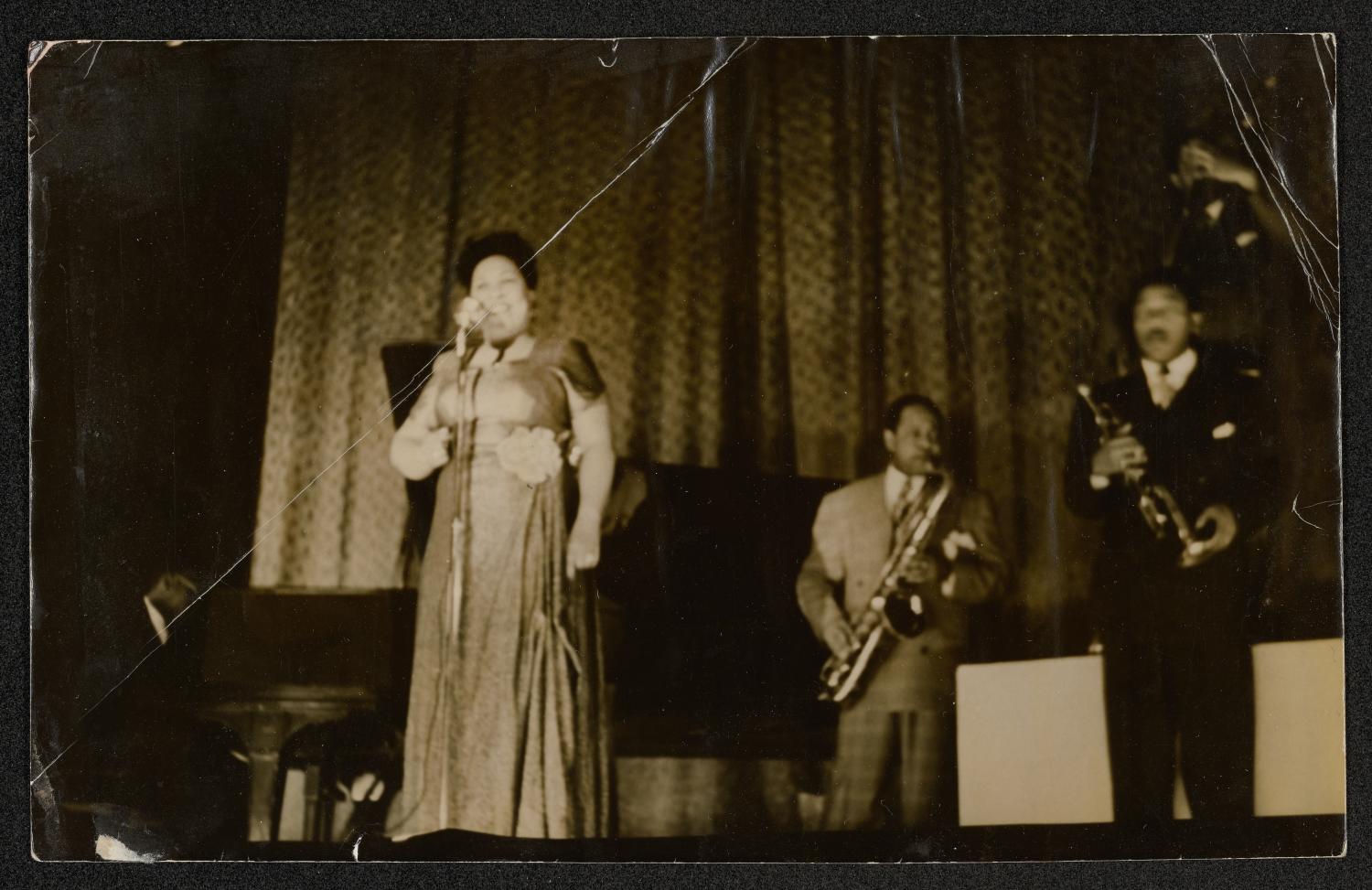
As of today, the collection holds 527 photographs. Even with some damage, these are a treasure, like the numerous images of Eldridge's short-lived big band, the JATP tours with Norman Granz, or the December 7, 1945 gig by this group:
  • Coleman Hawkins, "Texas Tom" Archia: tenor saxes
  • Roy Eldridge: trumpet
  • Thelonious Monk: piano
  • Al McKibbon: bass
  • Denzil Best: drums
  • Helen Humes: vocals
Thelonious Monk, Helen Humes, Coleman Hawkins, Roy Eldridge
(Source)
Let it be a reminder that there is lot of jazz beyond the records.

Friday, August 24, 2018

Zoot greets Getz

Zoot Sims, Tião Neto, Stan Getz at A&R Studios, NYC. March 18/19, 1963
(Photo by Jim Marshall. Source: JazzTimes.)

Zoot Sims (left) and Stan Getz (right) had a common history beginning in the summer of 1947 in a rehearsal band for which Gene Roland wrote the arrangements. This eight-piece group led by trumpet player Tommy DeCarlo and also comprising Herbie Steward and Jimmy Giuffre was spotted by Ralph Burns and eventually led to Woody Herman's signing the saxes minus Giuffre—Herman had already signed Serge Chaloff for the bari chair.

Monday, July 16, 2018

Image and sound: Webster Hall, 1956

One satisfaction of researching jazz photography—for it is a lot of fun—is the rare occasion when the images can be married to sounds. The book The Sound I Saw (Phaidon Press, 2011) by Roy DeCarava (1919-2009) includes a beautiful collection of black and white images, many of jazz musicians, with no credit whatsoever. Checking faces, names and discographies like this one, there are two photographs which can be pinned down, taken at the magnificent Webster Hall, RCA's regular studio in NYC at the time. These:
Tony Scott and orchestra, Webster Hall, NYC,
Friday, December 14, 1956
Left to right: Frank Foster, Danny Bank (with back to the camera), Frank Wess, Sahib Shihab,
Gigi Gryce, Tony Scott; same date and location.

Saturday, February 18, 2017

Barbara Carroll's first gig in NYC

(All the photos below are by William P. Gottlieb, and are available at the Library of Congress website.—click on them for a larger view.)

Pianist and singer Barbara Carroll passed away on February 12. She was 92, and hadn't quite retired. She was a two-handed pianist, as Hank Jones and Billy Taylor were, with big ears, and was active throughout her life, with a pause in the 1960s to raise a child. She has plenty of music available, much of it in trio format. Her "repertory" recordings for SESAC from 1959 (available as a download or via streaming through the "... And More Bears" label) are well worth a listen.

Carroll had piano lessons from a very early age, and attended the New England Conservatory, although her enthusiasm was aimed at jazz. During World War II, she toured her all-fermale trio around army camps in that part of the country, and after that, when she was just 22 years old, she landed her first gig in the Big Apple, almost by chance...
"When I came to New York, I knew nobody there except one musician, who introduced me to an agent, and immediately he was fortunate enough to get me a job opposite Dizzy Gillespie’s big band. I had a trio of my own, which consisted of Chuck Wayne on guitar, Clyde Lombardi on bass, and myself. Needless to say, I was so impressed with these two marvellous musicians I was working with that I was practically overwhelmed. Plus sharing the engagement with Dizzy’s band, which at that time included some great players like Ray Brown on bass, John Lewis on piano. Really fantastic."

Barbara Carroll, Clyde Lombardi, Chuck Wayne
Downbeat Club, c. 14-20 August 1947

Friday, January 16, 2015

Chicago, 1941, the blues (but no Earl Hines)

While browsing a recently, and lavishly, published book about a historical jazz record label, I saw this picture:

Source Shorpy.com
In the book the picture comes cropped and tilted, and the caption reads "Earl Hines at the mic during a gig in Chicago, April 1941". But that's not Earl Hines. Not even close.

Shorpy.com, where I found this version of the image, carries this caption: April 1941. "Tavern on the South Side of Chicago, Illinois." Acetate negative by Russell Lee for the Farm Security Administration. Interestingly, in the comments section someone says "looks like bandleader and pianist Earl Hines is at the mike". Oh, well...

Monday, December 15, 2014

Which studio is this?

As part of some research I'm carrying out, I need to identify the studio where these pictures were taken. I'm certain it's in or around New York, and the date is circa 1960. The (jazz) musicians' identities are irrelevant and have been obscured to avoid any copyright problems. Our graphic team has also colored a bass drum blue: it appears on all three images and it can help giving an idea of the dimensions and disposition of the place.

For what it's worth, the recording was published by a small, independent label. 

Any help will be most welcome and duly acknowledged.

(Click on each image to enlarge)


*


*

Tuesday, April 15, 2014

Billie Holiday, Club Bali... and the Internet

It’s funny how some people sometimes long for the great filters of olden days, when there was no internet, from record producers and publicists who had some influence on what music was commercially released or not, to professional journalists and editors who produced well-written, fact-checked copy. Those filters were by no means perfect, but they had their role.

Consider this picture. It was, probably still is, one of the first results when you type “Ray Bauduc”, “Walter Page” or “Claude Hopkins” on the world’s most-used search engine (owners of the blog-platform you’re reading this on). Those are minor names in the great scheme of Western culture. If you type “Billie Holiday”, you’ll probably see this picture too sooner than later.


Thing is, those are not Ray Bauduc, Walter Page or Claude Hopkins.

Friday, July 12, 2013

Party at the Barnes's!!! (part II)

George Barnes
I hope you enjoyed yesterday's video of "Liza", from George Barnes's Guitars Galore album, released in 1961. The beautiful montage was produced by Alexandra Barnes Leh, daughter of George's, who's also producing the George Barnes Legacy collection. This website is not to be missed, especially if you're in the least interested in the history of the guitar in America. Barnes was a true, multi-faceted pioneer, one of those larger-than-life characters, who was gone too soon, in 1977.

At the end of this text you can see some screenshots taken from the video. From the smiling faces, it’s pretty clear that everybody had a ball. Musicians from this era are remembered for their witticisms, their pranks, their humour… their ability to have fun in any given situation. Thanks to Alexandra and her mother, and wife of George's, Evelyn Barnes, we have some details from this actual party. Our deepest gratitude goes to both of them.

Monday, June 20, 2011

The faces of Freddie Moore

Drummer Freddie Moore (1900-1992), pictured by William P. Gottlieb
Freddie Moore is the drummer on Sidney Bechet's "Tiger Rag" (Blue Note, 1949), where he can be heard blowing on the snare drum (from 1:08 onwards.)