Showing posts with label blues. Show all posts

Thursday, June 20, 2019

Robert Johnson and the electric guitar

What is it about Robert Johnson that invites speculation? From his (re)appearance in popular music in the 1960s, to his resurgence in the early 1990s, he must be the African-American musician about whom most drivel has been written and spoken.

Now that the biography by Bruce Conforth and Gayle Dean Wardlow is out—my review: essential reading—, speculation should diminish significantly. Never mind that, I now offer you a bit of guessing, at least to provide some context regarding Johnson and the electric guitar, an instrument with a tradition in blues and rock heavily influenced by Johnson, even though he never really played it himself.

Sunday, May 17, 2015

The King is dead, long live the blues

BB King by Naiel Ibarrola

BB King has died, and it feels like the end of an era. There are artists who seem to have been "always there"; in King's case, he was already playing when my father was a toddler; when he released his first hit, "Three O'Clock Blues", Elvis was 16. He's also the last world-wide known bluesman to have come from the cotton fields of Mississippi, where he was born in 1925. He certainly is the last bandleader to have gone from playing the "chitlin' circuit" to packing the most select venues in the world.

It is the end of an era.

Friday, January 16, 2015

Chicago, 1941, the blues (but no Earl Hines)

While browsing a recently, and lavishly, published book about a historical jazz record label, I saw this picture:

Source Shorpy.com
In the book the picture comes cropped and tilted, and the caption reads "Earl Hines at the mic during a gig in Chicago, April 1941". But that's not Earl Hines. Not even close.

Shorpy.com, where I found this version of the image, carries this caption: April 1941. "Tavern on the South Side of Chicago, Illinois." Acetate negative by Russell Lee for the Farm Security Administration. Interestingly, in the comments section someone says "looks like bandleader and pianist Earl Hines is at the mike". Oh, well...

Thursday, July 17, 2014

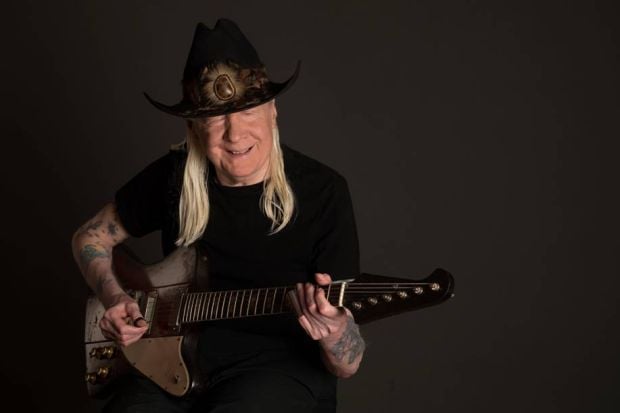
Remembering Johnny Winter

Johnny Winter

"I just hope I’m remembered as a good blues musician."
—Johnny Winter, just a month ago, here.

With his mane of white hair and willowy constitution, Johnny Winter was very easy to spot. He was also one of the true electric guitar heroes. He's passed away while on tour in Zurich, Switzerland, on July 16 according to his representative. He was 70.

Given his longevity and visibility, there'll be obituaries everywhere summarizing his life, his ups and downs, and his music. For many, especially the followers of less amplified musics, he could be loud and strident. His mid-1980s LPs, victims to the mastering practices of the time, are a good instance of that brittle, piercing sound. Still exciting blues and rock'n'roll if you ask me. Like so.

Saturday, February 1, 2014

A 60th birthday of rock guitar (possibly)

Fans of any kind of music just love a good discussion on pioneers, on who was the first to do something, and none more so than electric guitar fans. The heroic, macho player, not too different from characters in James Bond or Western movies (guitar slingers, guitar heroes...), lends itself to this kind of speculation.

One such discussion about the first guitar hero recently involved sailing upstream your typical "great man" narrative. Take, say, Eddie Van Halen. Hendrix. That kind of revered, popular guitarist. Jeff Beck. Clapton. Electric wizards with very heavy blues leanings. Creators of new sonic worlds on a fairly new equipment and its complements, of new techniques, new resources, uniquely able to stand in front of tens of thousands mesmerized people. Mike Bloomfield, co-conspirator of Bob Dylan's electrified and electrifying appearance in Newport. And then, circa 1960, the tracks seem to disappear. However, if I had to point to an early example of really outrageous guitar, combining a very early date of recording and release to the public, and ground-breaking playing, my vote would go for a tune recorded 60 years ago today. This one:

(Play as LOUD as possible)


Yep. That is "Space Guitar", a tune Johnny 'Guitar' Watson recorded, two days short of his 19th birthday, on February 1, 1954. It was released the following month as by "Young John Watson" on the Federal label as single #12175 (b/w "Half Pint A-Whiskey").

Thursday, July 18, 2013

The Blues: black, white... and red? (and III)

With today's text we reach the end of the excerpt first published on line by UTNE Reader from The Guitar and the New World, the new book by Joe Gioia. Once again, our thanks go to the author and the publisher, SUNY Press. If the earlier parts (the first and the second) sound interesting enough, the rest of the chapter “Hey-Hey” digs wider and deeper into some of the points made so far.

As it has happened with some of the books mentioned by Gioia in the second part (especially Hamilton's), his may be difficult to accept for its ground-breaking view of the origins of the blues, a unique genre about which people have been capable of keeping a straight face while talking of deals with the devil. On the other hand, Gioia's book may well go through the same heavy revisions as Charters's and Oliver's books in the future. Even in that case, the oversight Native Americans have suffered in this whole story of the music of North America is so enormous, that what's really important in Gioia's discourse is not so much whether his answers are correct, but the questions he asks; not what he's found, but the fact that he's pointing his torch in a different and hardly explored direction.

At "worst", the book can also be used as the author's guide to North-American music from the first half of the 20th century. Although some tracks may seem out of place without the book at hand, almost all the songs he mentions are included, in order of appearance, in this Spotify playlist (the links in the text lead to YouTube).

Back to the text: Having argued that there is sufficient reason to consider seriously the role of Native Americans in the origins of the blues and other musics from the US, the author keeps following that trail, and he begins to find some clues...

Wednesday, July 17, 2013

The Blues: black, white... and red? (II)

Second part of the excerpt from the chapter entitled "Hey, Hey", taken from Joe Gioia's The Guitar and the New World. In the previous part the author pointed out the two early 20th century seminal accounts from which all blues historiography emanates, Charles Peabody's and W. C. Handy's, and how from there its origins have been linked to slavery or even to Africa without any solid evidence to prove it.

Thanks to Joe Gioia and his publisher for granting permission for me to translate this text and publish it here. The complete excerpt is readily available on line at the UTNE Reader website.

Tuesday, July 16, 2013

The Blues: black, white... and red? (I)

One of the most fascinating aspects in the history of American popular music is the origin of blues music. Having been put at the centre of most of 20th century popular music, the seed of a mass phenomenon such as rock, the contrast with its humble origins in the Mississippi Delta give an epic air to a genre which is already elating and gut-wrenching in itself. If it's also considered as the musical undercurrent of the kidnapping, the trans-Atlantic trip, and slavery of Africans and their descendants in America, myth-making is hard to avoid.

Moreover, on top of this myth a sediment has formed which hardly lets any room for legitimate discussion regarding the origins of this musical genre, a sort of thick dogma compressed by considerations on authenticity. These are always useless, because if we consider history to be a film, authenticity is, at best, just a frame, a random image chosen according to a number of prejudices, selected to be an absolute and non-negotiable model against which the rest of the film is humbly compared. I say at best because normally authenticity isn't even a frame in the film, it's just an idealized utopian past.


Charley Patton - "I Shall Not Be Moved"

In some unproven way, blues is supposed to have been the musical baggage of slaves brought from Africa to America and their descendants. In the beginning, it was just purely a black thing, then it went losing its purity because of white influence of European origin. If we extrapolate that imagined trajectory, the origins of blues would lay in Africa. For a number of reasons, among them the choking and very real presence of racism in the US, the study and debate on what we know as the blues are constrained by some solid barriers. For instance: when it is insisted so much on the black/white racial dichotomy in American music, aren't we forgetting someone?

Wednesday, November 23, 2011

Blues for Paul Motian, 1931-2011

Eddie Costa on piano
Wendell Marshall on bass
Paul Motian on drums

- 1959 -


***

Thursday, April 14, 2011

Thursday's pill: Lewis Porter's blog

©Ed Berger, 2006
Last Monday I recommended some serious reading about jazz. Today I bring you some more. Dr. Lewis Porter (pictured) is one of the most consistent authors about jazz in the last few years. A pianist (here, with Dave Liebman) and one of the prime ideologists on how jazz research should be carried out, as well as founder and director of the Masters in Jazz History and Research Rutgers University (New Jersey) and acclaimed biographer of John Coltrane. Perfect Sound Forever interviewed him thoroughly, mainly about those two subjects, jazz research and Coltrane. Dr. Porter is a staunch empiricist, a giant in jazz knowledge, not so much as an erudite - that's what encyclopedias are for - but for the independence and originality of his work. He's one of the few authors on jazz who can be recommended unreservedly. With the help of MA student Alex "Lubricity" Rodriguez and under the auspices of WBGO, he started a blog a couple of weeks ago. Right after his introduction, where he states that

Experience has shown me that jazz musicians, fans, authors and teachers are reluctant to give up their old stories. This series will challenge you to change how you talk about jazz. Guess what? You can do it! Read, comment and share so that we can all work to spread accurate information about our beloved music, free of distracting myths and rumors.

he introduces, to that end, a proto-blues recorded in Congo in 1906! Nice way to start a blog! Dr. Porter explains

African MELODIES [not only rhythms] have survived in African American music--especially the blues--and this recording proves it! [...] Not only can you hear the flutist(s) playing very familiar blues licks over and over, he constantly goes back and forth between the major third and the “blue” third!

Besides explaining that small technicality, in this entry you can listen to the whole recording on line, here. Next entry is scheduled for today, Thursday 14th. Don't miss it!

PS: Today's entry is about the origins of the word "jazz", and it's here. Not to be missed.