![]() |
| Carson Smith and Charlie Parker |
Friday, November 10, 2023
Charlie Parker and Chet Baker 70 years ago
Tuesday, August 8, 2023
Steve McQueen's vinyl collection
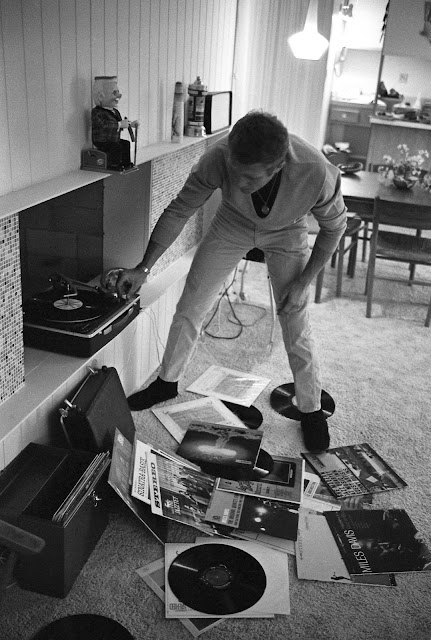
His ability as an actor aside, Steve McQueen was a photogenic man, as proved by the work of photographers like William Claxton and John Dominis. The latter, who's been featured in this blog before, took this image below, which may be familiar to music lovers.
| Steve McQueen in 1963 by John Dominis ©John Dominis/Time & Life Pictures/Getty Images (source) |
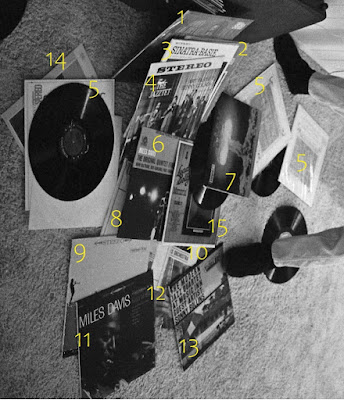
If you're reading this, you've probably wondered what are those LPs spread all over Mr. McQueen's floor (we want to believe he's not stepping on one of them). If that's the case, I think I have been able to identify all the sleeves, even those only partially visible.
The two immediate conclusions are, firstly, that McQueen must have had some direct or indirect contact at Atlantic Records: not only is the label with most LPs in the room, but there seem to be up to three copies of one album.
Secondly, this collection of LPs, mostly stereo, is of its time. Even though LPs recorded and published in the mid-1950s could already considered to be high-fidelity soundwise, from about 1957 recordings are made also in stereo—often in paralel to mono—and towards the end of that decade stereo sound becomes the norm, with the popularity of hi-fi.
Given the rising tide of hi-fi equipment, record labels on the one hand phased out mono sound, and on the other they adapted their existing and still recent mono stock to the new stereo sound, through processes of "remastering" or "rechanneling", which at times didn't amount to much more than playing the same music through both left and right channels with minor differences in equalization or phase in order to give the listener a sense of space, of "stereo". This is the case with at least two of the LPs in the list below, numbers "6" and "14". The rest are LPs published in stereo, except for two instances of mono issues.
I've numbered the LPs in the image below. I've also added links to Qobuz (for audio) and Discogs (for info on the LPs).
Finally, it is quite clear that Mr. McQueen had excellent taste, or he knew how to be advised on musical matters.
| (Click on the image to enlarge it) |
Wednesday, November 16, 2022
Lennie Tristano Personal Recordings 1946-1970: The contrafacts
![]() |
| (Mosaic/Dot Time MD6-272) |
Wednesday, October 5, 2022
On Oscar Pettiford's centennial
| Oscar Pettiford in Newport, 1958 (screenshot from Jazz on a Summer's Day) |
Friday, February 4, 2022
Miles Davis: February 4th, 1958—in pictures
On Tuesday, February 4th, 1958, at Columbia Records' studio on Manhattan's 30th St., a session was booked for the afternoon. It lasted from 2 to 6.30 pm, with Harry "Chappy" Chapman, an in-house veteran going back to the early 1940s, manning the control room.
The musicians and producer involved may have not known it at the time, but this was to be the first of two momentous occasions: this session and the following one, on March 4, were to be the last produced for Miles Davis by George Avakian, who had put him in the map by signing him to Columbia, the label he ended up staying with for thirty years, between 1955 and 1985.
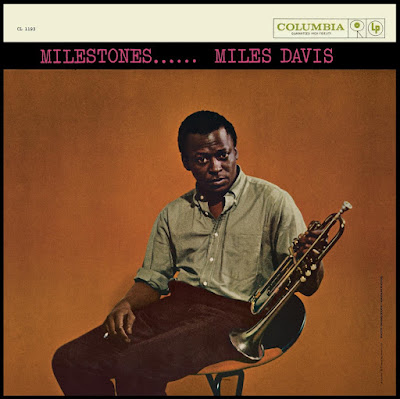
These sessions on February and March 4 would also be the last ones by Davis's "first quintet", with Red Garland on piano and "Philly" Joe Jones on drums. Together, they'd form Milestones, a, er, milestone in Miles Davis's career, which may have seemed unsurpassable at the time. Not for long, though: his next small group album would be Kind of Blue.
| Cover of Milestones. Photograph by Dennis Stock. |
Monday, December 20, 2021
Betty Glamann's Christmas album (and why discography matters)
A precocious talent, Glamann was already performing with a symphony orchestra twice a week on NBC radio when she was 13. From there, she played in the Baltimore symphony, then joined the eccentric but demanding Spike Jones and appeared on Garry Moore and Steve Allen's TV shows. She can also be heard on jazz records, like Duke Ellington's A Drum Is a Woman, Kenny Dorham's Jazz Contrasts, Michel Legrand's Legrand Jazz and in Oscar Pettiford and his Orchestra's Vol. 2 (reissued as Deep Passion).
In the mid-1950s, she recorded two albums, Poinciana for Bethlehem, and Swinging on a Harp for Mercury, as the co-leader of a small group with bassist Rufus Smith, featuring top-rank sidemen like Barry Galbraith, Osie Johnson or Eddie Costa. And some time around 1967 she did a Christmas record for the obscure Vicson Music Company.
Saturday, July 24, 2021
Dr. Billy Taylor and "The Subject is Jazz"
![]() |
| Dr. Billy Taylor (source) |
His first professional gig was under Ben Webster at the Three Deuces in 1944. From then on, he played, literally, for everybody; in 1946 he toured Europe with Don Redman and stayed in Paris for a while. In 1951, he became house pianist at Birdland, and soon after he started his own trio.
That's just the beginning of his vast credentials as a player — he was a renowned player for all his long life, a foundation as solid as anyone's for his other musical endeavours.