Thursday, October 10, 2013

Monk's pieces

(2022-10-10 update: the Black Lion recordings are now available on streaming platforms. I have also added the late Frank Kimbrough's take on "A Merrier Christmas". The playlist is now also on Qobuz in SQ equal to or above CD.)

Because of his name, his looks, his life, the way he played, which some see as some sort of overarching weirdness, Thelonious Monk is one of last century’s most recognizable jazz musicians.

He was a very interesting composer too. Firmly anchored in the popular-song-and-blues genre, he left under a hundred pieces, some which have become well-known standards.

However, there's much more than the half-dozen overused items of Monkiana that we all know. Since today it's his birthday, I'm posting this almost-complete Spotify playlist, based on the list of Monk's compositions at MonkZone website, with all that is known and, perhaps, not so known from him.

Missing from the playlist are "Harlem Is Awfully Messy" (copyrighted but never recorded), and "A Merrier Christmas" (of which there's a private recording with Monk singing—this version is by Dianne Reeves with Benny Green).

Comments, additions, corrections, will be most welcome.

Wednesday, September 11, 2013

Benny Goodman at Carnegie Hall: new reissue, still incomplete

Benny Goodman at Carnegie Hall 1938 is an iconic record. It has been in print since 1950, and it offers a great snapshot of Swing at his height, not only musically but socially. However, to this day we don't have a complete issue of the music, as I explained in this previous post.

There's a new reissue just out—Benny Goodman at Carnegie Hall 1938, Sony Music Entertainment (Japan) Inc., Blu-spec CD2 SICP 30223-4. This has been released in the new Blu-spec CD2 format, but it's based on the previous official CD master (C2K 65143, from 1999), and therefore it's still missing half a minute of music, although the sound seems to have gained definition.

Wednesday, September 4, 2013

Unexpectedly... Biréli Lagrène

There are records that are not so good, but still hold pleasant surprises. Some are even memorable for just one tiny moment of glory.

One of those would be Jaco Pastorius's Stuttgart Aria. An irregular album, and Jaco's last, it rewards the listener who gets to its very end with Biréli Lagrène's solo on "The Days of Wine and Roses"; Lagrène was just 20 when he recorded it.

Biréli Lagrène is 47 today.


PS: Some years later, Jazzpoint released a double CD, Broadway Blues & Teresa, with music from the Stuttgart Aria sessions, without the keyboard overdubs. In Spotify you can listen to this reading of "Days of Wine and Roses", without synths.

Monday, August 5, 2013

Jazzaldia 2013: days 2-5

(This is a digest of the more detailed account of the 48º Heineken Jazzaldia, the annual summer jazz festival in Donostia/San Sebastián, Spain, which can be found in Spanish, here. You can read about day 1 in English here.)

As vilified as it may be, the European summer jazz festival circuit must surely come as a blessing for many, musicians and fans alike. Besides the opportunities to work for the former, and to enjoy quality live music for the latter, it's a good chance to meet up with old friends who become part of the landscape for a few days a year.

One of those chance meetings: John Zorn and Lee Konitz
(© Fernando Ortiz de Urbina)

Saturday, July 27, 2013

Jazzaldia 2013....

Apologies to my readers in English. Daily chronicles of the concerts at Jazzaldia are proving hard enough for me to contemplate translating them into English on a daily basis too.

Bear with me for a few days and I'll file a detailed report on the event. You're always welcome to read the reports in Spanish.

As ever, thanks for reading!

Thursday, July 25, 2013

Jazzaldia 2013: day 1

© Fernando Ortiz de Urbina

The succession of free gigs around the Kursaal auditorium make the first day of Jazzaldia a whole different business from the rest of it. For some, it's joyful and a communal experience. For others, it's the mob.

We're all old enough too keep banging on about stylistic considerations and ask ourselves what do we really want from music. At best, it should make us dance and jump, reflect and scream, laugh and cry... while it tears our hearts out like Indiana Jones' and replaces them tenderly, as many times as it wishes.

Jazz, music, art in general, at their best, seem to stem from this dialogue:
—What if we do...?
—Why not?!
© Fernando Ortiz de Urbina

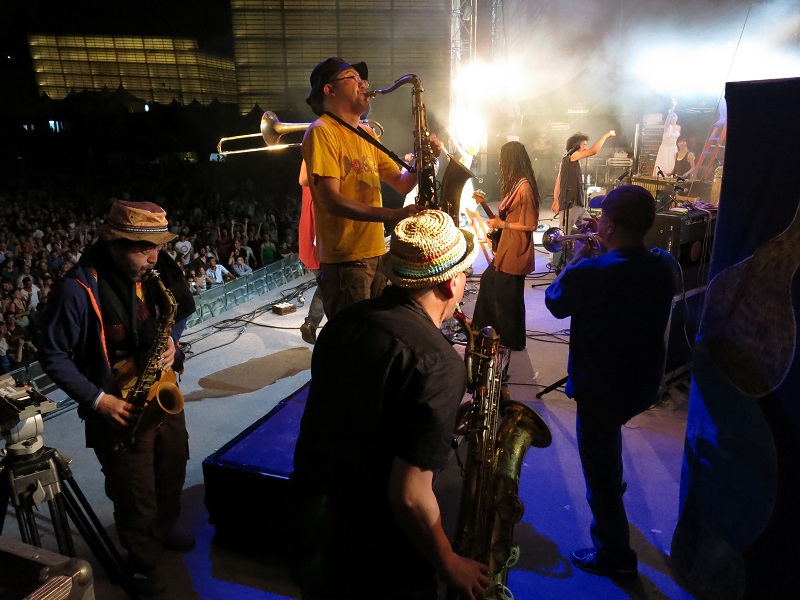
What if we put together a band with two drum kits, a vibraphone, assorted percussion, electric bass, two electric guitars with their respective effects, a horn section (trumpet, alto, tenor and bari saxes), a theremin, voices... and, actually, whatever else we may think of. We could also add some dancers. And a painter working during the gig. And a big video screen in the background. How about a giant jellyfish-shaped balloon? Make it fly over the stage. And over the audience too.

What if this orchestra plays music with plenty of vamps. Like the Mission Impossible theme. Music for dancing. Lots of it. And binary rhythms, like Sabre Dance. And in three. And in four, that's perentory. And in five, like Dave Brubeck could never imagine. And some of that jazz that goes from Mingus through Bill Barron's ensembles to Mostly Other People Do The Killing. And rock guitars. And some nice chord sequences. And monster unisons. And polkas. And some ska...

All of the above exists and has a name: SHIBUSASHIRAZU ORCHESTRA, which unlucky Cinderellas missed on the 24th. That, and the chance to see the whole of Zurriola beach jumping and dancing at 2 a.m. On a Thursday.

Shibusashirazu Orchestra
© Fernando Ortiz de Urbina

Earlier that evening...

ROBERT GLASPER: quartet. Funk is like a good dessert. It can save anything. Take a good bassist (Derrick Hodge) and a good drummer (Mark Colenburg), and you'll be able to play anything on them. Vocoder is not such a versatile resource as some seem to think. One of the best moments happened with Casey Benjamin on alto sax and without Glasper. Ponder that.

Tuesday, July 23, 2013

Rock interlude: Alchemy


Alchemy is a live album by Dire Straits, possibly the band that made the most money in the crazy Eighties, when British pop/rock seemed to embrace thatcherism and conquered a sizeable chunk of worldwide record sales. Actually, the Straits' next tour would be a gruelling one year away from home, so designed, apparently, for tax purposes.