Showing posts with label piano. Show all posts

Saturday, July 24, 2021

Dr. Billy Taylor and "The Subject is Jazz"

Dr. Billy Taylor (source)
Dr. Billy Taylor (1921-2010), whose centennial we celebrate today, debuted on record in March 1945, right when the Parker/Gillespie revolutions was exploding. He had become a professional musician earlier, with his ears attuned to what he called "pre-Bop" (what Don Byas, Budd Johnson, Charlie Christian or Clyde Hart played). 

His first professional gig was under Ben Webster at the Three Deuces in 1944. From then on, he played, literally, for everybody; in 1946 he toured Europe with Don Redman and stayed in Paris for a while. In 1951, he became house pianist at Birdland, and soon after he started his own trio.

That's just the beginning of his vast credentials as a player — he was a renowned player for all his long life, a foundation as solid as anyone's for his other musical endeavours. 

Friday, October 9, 2020

Jamal v. Shearing (or let's hear it for Crosby & Fournier)

The piano is one instrument where comparisons between musicians are easier to make. There are no two identical pianos in the world, but the common mechanics, the inability to bend notes (Monk notwithstanding) and the generally untouched, acoustic sound are a better yardstick than any other instrument (the triangle, perhaps) to tell musicians apart—case in point: in 1958-1959, Dave Brubeck and Bill Evans were recorded  at the same studio, Columbia's "church" at 30th St.,  and it's likely that at some point they used the same piano, and yet they're easily identifiable.

Pianos at Columbia's 30th St. studio (source)

Sunday, March 17, 2019

Nat "King" Cole, pianist

In this week of jazz centennials (Mercer Ellington on the 11th, George Avakian on the 15th, Lennie Tristano on the 19th), today we celebrate Nat "King" Cole's. He was a great singer, especially given his limited resources and a popular entertainer. He was also a terribly influential pianist—Lennie Tristano and Hank Jones certainly listened to him—who helped establish the piano trio, albeit with a guitar instead of drums, the format Oscar Peterson, another Cole fan, maintained until mid-1959.

Cole recorded a lot with his trio, both for commercial release (for Decca, and later Capitol) and for radio broadcast (or transcriptions). Among the latter, there is a recording called "Miss Thing", effectively a reduction to the trio of the Count Basie Orchestra side "Miss Thing (Part II)", which shows a lesser known aspect of Cole's musicianship.

Basie's "Miss Thing (Part II)" (early 1939)


Cole's "Miss Thing" (late 1943)


Friday, June 20, 2014

The joy of Horace

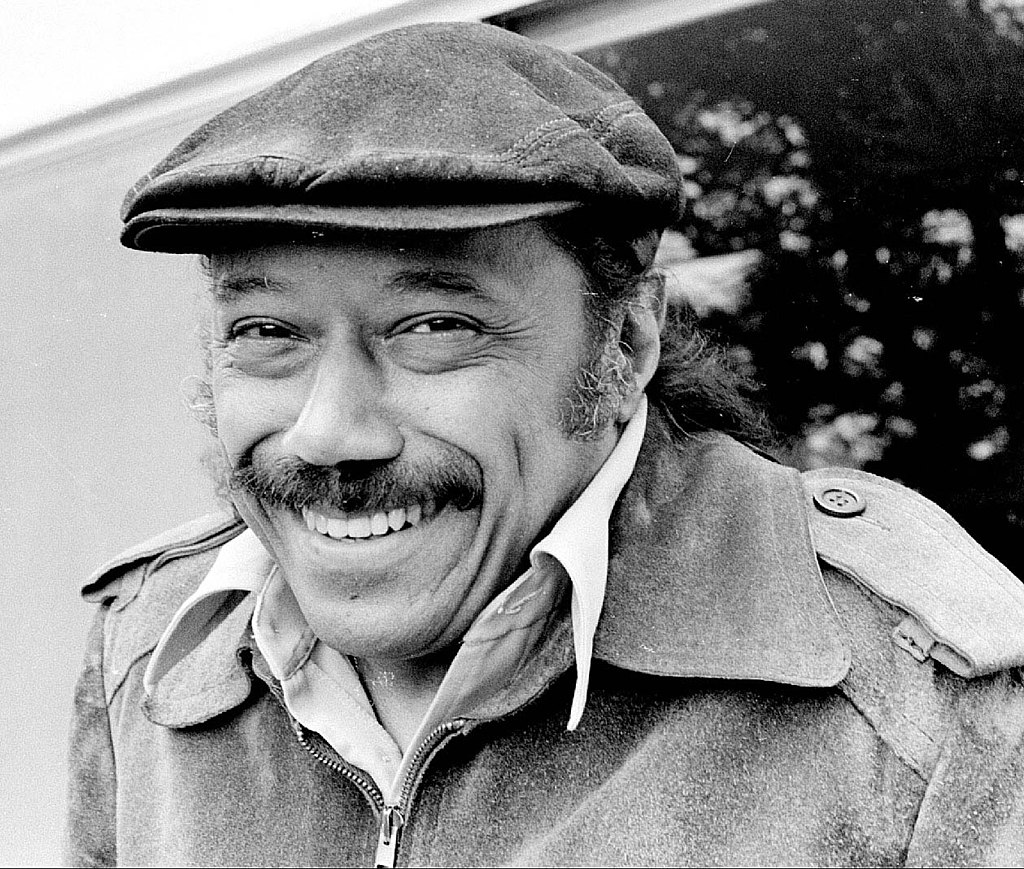
Horace Silver pictured in 1989 by Dimitri Savitski (Wikipedia)

Since back in 2007 when bassist Christian McBride made a passing comment on Horace Silver's Alzheimer, his passing yesterday was not unexpected news (so much so, that a rumour became news and spread like fire earlier in the year).

There are very fine obits around (like this one) about Silver's wonderful life, so we'll skip that.

His legacy, what remains after the man's gone, is phenomenal. As a piano player, his style was very rhythmic (watch out for that left hand, which can also be heard in contemporaries such as John Williams and Eddie Costa) and somewhat sketchy, as if he was dotting down ideas for new compositions as he was playing them. A prolific composer and a tasking leader, his music was lively, bluesy, gutsy, churchy, with feeling.

Tuesday, March 25, 2014

Portrait of Cecil Taylor as a young man

Playing the music(s) we call jazz is not an easy life, neither regarding the art itself, nor as a way to make a living. The reasons for anyone to follow that path fall beyond the realm of logic; art is a tricky business, and longevity and sheer stubbornness do not necessarily bring about recognition and financial support for the artist’s work. Luck and chance can make or break a career. Even so, there are men and women who work relentlessly to realize whatever shakes their spirits. If there is one musician who’s taken his art to an overwhelming standard of technical virtuosity, swimming against the strongest tides of disapproval, that must be Cecil Taylor, who turns 85 today.

© Naiel Ibarrola, 2014
Years before Ornette put any music on record, before Coltrane stepped firmly into the unknown, Taylor was hammering his way into the scene in New York, but he never quite made it, even if he was the first jazz act at the now legendary Five Spot, turning it into a bona fide jazz venue. He was not only aware of jazz and its traditions, but he claimed that his approach to form and composition was based on Duke Ellington's, and, being an astonishing virtuoso, had very definite ideas on the value and role of technique in fellow pianists such as Thelonious Monk and Horace Silver, two clear instances of technique being the consequence of the music itself. Even so, his arrival must have been similar to Henry Cowell's in the "classical" world, thirty or forty years earlier.

Tuesday, January 7, 2014

Duke Ellington at the piano


“[…] Duke, in spite of what some people might think, was an excellent pianist.”
(Pianist Hank Jones, in an interview with Ted Panken)

A lot has been said in recent weeks about Duke Ellington on the Internet. A new biography by Terry Teachout and a review of it in The New Yorker by Adam Gopnik have raised a few eyebrows and made some people angry. I haven’t read Teachout’s book, but I know Gopnik’s review. The problem with it is that he seems not to have listened to much of Ellington’s colossal output.

Some of the criticism towards those texts have to do with Ellington’s relationship with his writing and arranging companion, Billy Strayhorn, and his piano playing. I think this recording of Strayhorn’s “Lotus Blossom”, made after his death, speaks volumes about both aspects.

Thursday, March 21, 2013

Keith Jarrett strides along...

Keith Jarrett (source)
Keith Jarrett is a jazz piano player who has crossed over to a level of fandom exclusive to a very few musicians in the world, regardless of their styles. If you're reading this, you've probably heard him, as a soloist, with his trio, maybe even in his early days with Miles Davis or Charles Lloyd.

However, it may also be that you've never heard him playing a Gershwin tune in a stride-piano vein (the first two and a half minutes in the following video).


In the comments on the YouTube page, some seem not to believe that this is indeed Jarrett. However, Norwegian musician Per Husby says this about the video:

I can confirm that the clip is actually Jarrett. The original tape now resides in the Norwegian Jazz Archives as part of the Randi Hultin collection, donated to the archives after her passing away.
However, the info regarding the actual recording is incorrect. The quartet part (the track is cross-faded into a concert version of Forest Flower by the quartet) may well have been recorded at the Oslo concert on May 7, 1966, but Jarrett played no solo performance, Tatum-style then (I know, I was in the audience). However, the day after, the quartet was invited to Randi Hultin's house to celebrate Jarrett's birthday, and on that occasion Jarrett sat down at Randi's piano and played several solo pieces, some of which was recorded by Randi on her home tape machine. (If you listen closely, I think you might hear Randi and Lloyd chuckling in the background a couple of places while he is playing). The whole recording is about 10 minutes long - so the YouTube thing is just a small excerpt. God knows where they got this clip from, though - they most certainly did not get it from Norwegian Jazz Archives.
  • More about Randi Hultin, here.
  • More about Per Husby, here (Wiki).
  • More about the Norwegian Jazz Archives, here.

Tuesday, July 31, 2012

The unforgettable Mr. Jones

Hank Jones's most famous gig
Today is Hank Jones's birthday. He was a wonderful pianist, elegance in person, whose career spanned over 60 years. Too mild for some, perhaps, but always honest to himself. He was also my first interview in English, back in 1996. He was patient, kind, and even thanked me for reminding him of the people he'd played with.

He passed away two years ago, but he's not forgotten.

These videos come from a 2004 master class, the first is an in-depth interview, the second has him playing. Also recommended is this article by Ethan Iverson.


The Very Thought of You.......01:43
Alone Together................06:41
Oh, Look at Me Now............11:15
Oh, What a Beautiful Morning..15:53
Six and Four..................21:07
Recorda-me....................26:12
Don't Blame Me................29:22
Polka Dots and Moonbeams......34:41
Bluesette.....................40:42
Monk's Mood...................44:31
Ain't Misbehavin'.............48:36

Sunday, May 20, 2012

Satchmo on Sunday

There's always something special in duets between a vocalist and an instrumentalist. Neither has anywhere to hide, but they do have more space to stretch out and more flexibility to accommodate each other. 

Whatever your taste, Louis Armstrong, Oscar Peterson and Herb Ellis are phenomenal musicians. Hearing them in this setting is just a delight. Both duets come from the 1957 Verve album Louis Armstrong meets Oscar Peterson (Verve/Universal 0602498840283).

Louis Armstrong (vocals) & Oscar Peterson (piano): "What's New?" (on MySpace / on Spotify)

Louis Armstrong (vocals) & Herb Ellis (guitar): "There's No You" (on MySpace / on Spotify)

PS: Go here for a more thorough post on "There's No You" by wunderkind Satchmologist Ricky Riccardi, whose book on Louis Armstrong, What a Wonderful World, is out now on paperback.