Showing posts with label Art Blakey. Show all posts

Tuesday, April 14, 2020

Jazz pour tous! (1959-1969)

Jean-Marie Peterken and Nicolas Dor present Jazz pour Tous!

The wonders of European TV archives never cease. Besides the more recent footage which is being rescued weekly from the vaults of Spanish TV (see here), we have now a bunch of programmes from RTB (Belgian public broadcaster) show Jazz por tous!, "Jazz for everyone!", which was broadcast for ten years from 1959. The show had actually started as a radio programme by Belgian aficionados Nicolas Dor (correspondent for American rag Record Changer covering Belgium, France, and the Netherlands)  and Jean-Marie Peterken, and it had a spin-off in the short-lived festival in Comblain-la-Tour, where Cannonball Adderley recorded his LP Cannonball in Europe in 1962.

Thursday, April 30, 2015

Hard bop repertory — a suggestion

(For Ira Gitler.)

The central position of hard bop in what is widely considered as the mainstream of jazz is an interesting phenomenon. It is paradoxical how despite its pervading presence, the lingua franca, thanks to the enormous recorded legacy, and even today, among students at music schools, there is very little literature about it. Whatever the reason, there are few biographies of musicians relevant to that genre — some don't amount to much more than listening guides —, and there's no definitive treaty of the music either (Rosenthal and Mathieson's books are clearly not enough), which, given that it would have to deal with African-American heritage more so than any other branch of jazz, it should be seriously considered by one or several scholars.

Going back to the first point, given the numbers of musicians who play in or around the hard-bop genre, among them many music students fresh out of schools, at least some of them must really like the music (in spite of all the cynicism by old farts who've seen it all). So here's my suggestion to those looking for a less-trodden path in that realm: why not explore Hank Mobley's compositions?

Hank Mobley at the Soul Station recording session, Sunday, February 7, 1960
(photography by Francis Wolff)

Wednesday, April 15, 2015

Recommended jazz recordings: a list of one


We are smack dab in the middle of Jazz Appreciation Month — pretty meaningless for some of us, but still a nice try at giving exposure to a sophisticated, exciting, and unlikely art form that cuts through class, racial and national considerations. In practical terms, this means events, photo-calls, blurbs, smiling faces... and lists of recordings. Of these we have many, past and present, and they tend to rely more on received wisdom and hype than on critical value — fine if you're OK with "this is great", but not so much if you need "this is great because...".

Besides, there's the wishfulness of recommending more than, say, five records to someone who's not really into jazz at all. With all the incredible stuff around us today, all kinds of music, books, films, TV... either physically or through the internet, an hour of undivided attention has become a luxury.

Because of that, and the fact that recommending anything above five records is an open door to political correctness (of all misconceptions about jazz, the one about its cultivated, unprejudiced listeners is the funniest) and, frankly, a way out for wimps, let's see if I can cut through all that background noise by telling you one (1) jazz album you should have.

It won't be anything by Louis Armstrong, Duke Ellington, Charlie Parker, Miles Davis, or John Coltrane. Those are extraordinary musicians, genres unto themselves, which are not representative of jazz. Say what? No, they're not. Go for any of those by all means, but don't think for a second that the rest of "jazz" is at the same level as the best of their recorded works; bear in mind their excellence and avoid future disappointments. And although many wouldn't admit this, you wouldn't be alone if your first impressions are that Kind of Blue is too slow, or Giant Steps is too overpowering (and don't get me wrong, those are masterpieces).

Friday, February 20, 2015

The joy of zest (introducing the Lucky Chops)

Every once in a while the tired discussion on how to bring jazz to people, or make it "popular" reappears. When it does, I always think of these two quotes.

Years ago, singer, pianist and raccounteur Ben Sidran asked Art Blakey to describe jazz in one word, to which the master drummer replied: 
"Intensity. Intensity. Intensity. Even on the ballads."
Sometime in the early seventies, trombonist, pianist, composer and arranger Bob Brookmeyer, a serious guy with zero tolerance to nonsense, said this, as published by Downbeat magazine:
"Above all, you're supposed to have a good time with it. Otherwise you missed the whole point, and you can't do that."
Well, admittedly the music on the video below is not jazz (let's not go into pointless arguments just now), but besides being a grand example of how much fun music can be (and of the value of music as a social tool—the baritone player is obviously nuts, and here he is, being useful to society), I think it provides a good hint of the zest that would be most welcome in any kind of music, and especially in (some) jazz.


(Same video, on Facebook)

Friday, September 21, 2012

The Blakey-Chambers duets

On Sunday, March 29, 1959, right between the two sessions that gave us Kind of Blue, the bassist on those, Paul Chambers (age: 23) and veteran drummer Art Blakey (age: 39) seemed to have got early to a recording session led by Sonny Clark.

According to Michael Cuscuna, who unearthed these tapes in the 1970s:
[...] another odd early find in the Blue Note vaults. I was systematically going through every reel of every unissued session. When I put on the first reel of an unissued March 29, 1959 Sonny Clark session, which was ultimately released as My Conception, there was not a piano note to be heard. The first two takes were spectacular performances of "I’ve Got My Love To Keep Me Warm" and "What Is This Thing Called Love" by what could be none other than Paul Chambers and Art Blakey. I never did find out why these came about (perhaps the rest of the band was late), but I’m glad they did.

Glad indeed. If Chambers and Blakey always maintained a very high standard in all their recordings, here, with nowhere to hide, they both give a masterclass in what a rhythm section should be. Without horns, Blakey can afford to be more subtle, which only makes him swing more, not less, as you can hear in "What Is This Thing Called Love?". In this less-is-more vein, Blakey's tour de force is actually, at least to my ears, the slower but still brisk Irving Berlin tune. His versatility with the drum set, or even something so simple-sounding like his playing behind Chambers's opening solo, is mesmerizing.


Available on Mosaic Select: Paul Chambers, and on Art Blakey's Drums Around the Corner


Monday, July 23, 2012

Jazz according to Branford Marsalis (and Blakey)

... one time [Ben Sidran] interviewed Art Blakey, and he said "if you had to describe jazz in one word, what would it be?" And Art said the same word three times. He said: "Intensity. Intensity. Intensity. Even on the ballads"... So, even if you have people who won't know what we're doing, they'll feel what we're doing.
From the video below, as seen on Doug Ramsey's Rifftides blog.
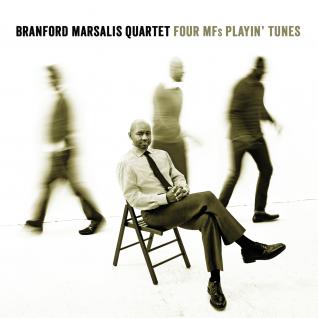
Branford Marsalis Quartet's new album, Four MFs Playin' Tunes, is out now.